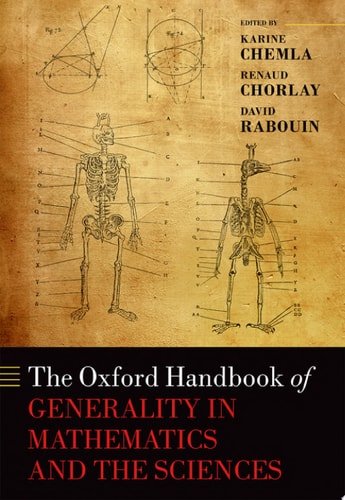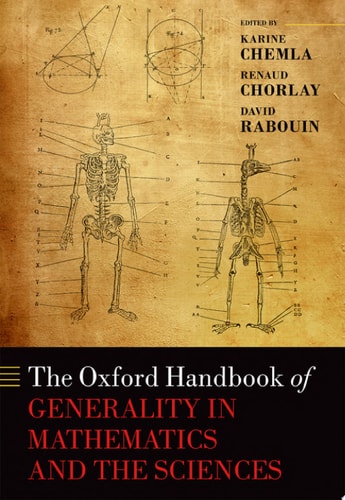
The Oxford Handbook Of Generality In Mathematics And The Sciences
0
0
As an Amazon Associate and affiliate partner, Menrva Books earns from qualifying purchases. Learn more
Author Description
Generality Is A Key Value In Scientific Discourses And Practices. Throughout History, It Has Received A Variety Of Meanings And Of Uses. This Collection Of Original Essays Aims To Inquire Into This Diversity. Through Case Studies Taken From The History Of Mathematics, Physics And The Life Sciences, The Book Provides Evidence Of Different Ways Of Understanding The General In Various Contexts. It Aims At Showing How Collectives Have Valued Generality And How They Have Worked With Specific Types Of General Entities, Procedures, And Arguments. The Books Connects History And Philosophy Of Mathematics And The Sciences At The Intersection Of Two Of The Most Fruitful Contemporary Lines Of Research: Historical Epistemology, In Which Values (e.g. Objectivity, Accuracy) Are Studied From A Historical Viewpoint; And The Philosophy Of Scientific Practice, In Which Conceptual Developments Are Seen As Embedded In Networks Of Social, Instrumental, And Textual Practices. Each Chapter Provides A Self-contained Case-study, With A Clear Exposition Of The Scientific Content At Stake. The Collection Covers A Wide Range Of Scientific Domains - With An Emphasis On Mathematics - And Historical Periods. It Thus Allows A Comparative Perspective Which Suggests A Non-linear Pattern For A History Of Generality. The Introductory Chapter Spells Out The Key Issues And Points To The Connections Between The Chapters.
Menrva's Summary
THE THESIS
This volume investigates how the concept of generality has functioned as a central, yet historically shifting, value within mathematical and scientific discourse. The editors, David Rabouin, Karine Chemla, and Renaud Chorlay, assemble a collection of original essays that examine how different scientific communities have defined, valued, and utilized general entities, procedures, and arguments across diverse historical periods. By integrating historical epistemology with the philosophy of scientific practice, the authors argue that generality is not a static ideal but a dynamic construct embedded within specific social, instrumental, and textual networks.
THE SCOPE MAP
What You Will Find
- Comparative analysis of generality in mathematics, physics, and the life sciences.
- A framework for understanding scientific values through historical and philosophical lenses.
- Self-contained case studies detailing specific scientific content and historical contexts.
Scope Limits
- The text does not provide a singular, unified history of generality, instead emphasizing a non-linear pattern of development.
- The volume focuses primarily on mathematics, with physics and life sciences serving as secondary comparative domains.
THE AUTHORITY PERSPECTIVE
Experts recognize this handbook as a significant contribution to the intersection of historical epistemology and the philosophy of scientific practice. Readers frequently note the academic density of the prose, which is intended for scholars and advanced students interested in the conceptual evolution of scientific methodology.
Page Count:
480
Publication Date:
2016-01-01
Publisher:
Oxford University Press
ISBN-10:
0191083054
ISBN-13:
9780191083051
Philosophy of
Physics
Mathematics
Life sciences
Science History
Epistemology