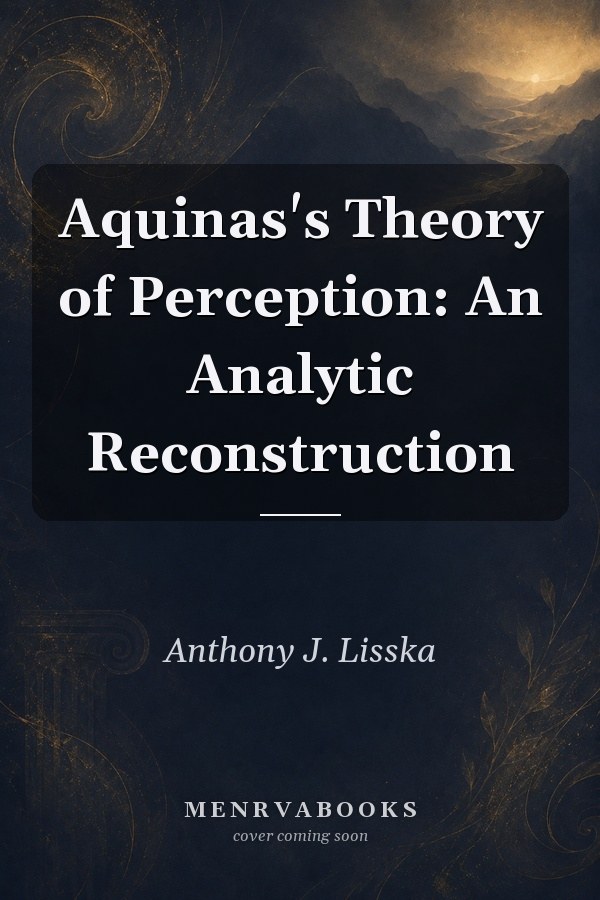
Aquinas's Theory of Perception: An Analytic Reconstruction
0
0
As an Amazon Associate and affiliate partner, Menrva Books earns from qualifying purchases. Learn more
Author Description
Anthony J. Lisska presents a new analysis of Thomas Aquinas's theory of perception. While much work has been undertaken on Aquinas's texts, little has been devoted principally to his theory of perception and less still on a discussion of inner sense. The thesis of intentionality serves as the philosophical backdrop of this analysis while incorporating insights from Brentano and from recent scholarship. The principal thrust is on the importance of inner sense, a much-overlooked area of Aquinas's philosophy of mind, with special reference to the vis cogitativa. Approaching the texts of Aquinas from contemporary analytic philosophy, Lisska suggests a modest 'innate' or 'structured' interpretation for the role of this inner sense faculty. Dorothea Frede suggests that this faculty is an 'embarrassment' for Aquinas; to the contrary, the analysis offered in this book argues that were it not for the vis cogitativa, Aquinas's philosophy of mind would be an embarrassment. By means of this faculty of inner sense, Aquinas offers an account of a direct awareness of individuals of natural kinds--referred to by Aquinas as incidental objects of sense--which comprise the principal ontological categories in Aquinas's metaphysics. By using this awareness of individuals of a natural kind, Aquinas can make better sense out of the process of abstraction using the active intellect (intellectus agens). Were it not for the vis cogitativa, Aquinas would be unable to account for an awareness of the principal ontological category in his metaphysics.
Menrva's Summary
THE THESIS
This book investigates the role of the vis cogitativa within Thomas Aquinas's theory of perception to determine how it facilitates the abstraction of natural kinds. Anthony J. Lisska, a scholar of medieval philosophy, utilizes a framework rooted in contemporary analytic philosophy to re-examine Aquinas's texts. By integrating insights from Brentano and modern scholarship, the author argues that the inner sense is a critical component of Aquinas's philosophy of mind rather than a peripheral or problematic element. The work posits that this faculty is essential for the direct awareness of individual natural kinds, which serves as the foundation for the process of abstraction.
THE SCOPE MAP
What You Will Find
- An analytic reconstruction of Aquinas's theory of perception
- A detailed examination of the vis cogitativa and its function as an inner sense
- A comparative analysis using Brentano's intentionality framework
- An explanation of how incidental objects of sense relate to ontological categories
Scope Limits
- The text does not provide a general biography of Aquinas
- The analysis is restricted to the philosophy of mind and perception rather than Aquinas's broader theological works
THE AUTHORITY PERSPECTIVE
Scholars frequently note the technical rigor Lisska applies to medieval texts, often highlighting his success in bridging the gap between scholastic thought and contemporary analytic philosophy. Experts recognize this work as a significant contribution to the study of Aquinas's cognitive theory, particularly regarding the often-neglected faculty of inner sense.
Page Count:
371
Publication Date:
2016-01-01
Publisher:
OUP Oxford
ISBN-10:
0191083674
ISBN-13:
9780191083679
Philosophy
Epistemology
Philosophy of
History & Surveys
Thomas Aquinas