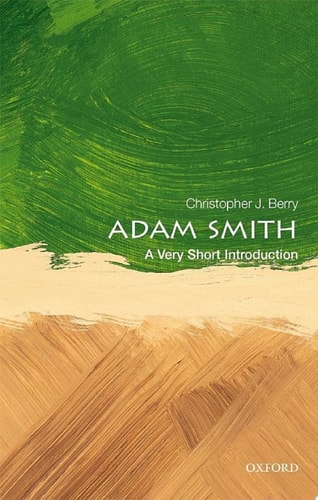
Adam Smith: A Very Short Introduction
0
0
As an Amazon Associate and affiliate partner, Menrva Books earns from qualifying purchases. Learn more
Author Description
In 1776 Adam Smith (1723-90) wrote The Wealth of Nations, a book so foundational it has led to him being called the 'father of economics'. Today he is associated with the promotion of self-interest, a defence of greed and a criticism of any governmental 'interference' in market transactions which, if left to the 'invisible hand', will produce prosperity and liberty. Yet if Smith is actually read these associations are more a caricature than a faithful portrait. In this Very Short Introduction, Christopher Berry offers a balanced and nuanced view of this seminal thinker, embedding his fierce defence of free trade, competition, and assault on special interests in contemporary European history, politics, and philosophy. As Berry explores, Smith was far more than an economist. His book The Theory of Moral Sentiment, offered a complex account of ethics in the context of human social behaviour. His scope as a professor at the University of Glasgow, a major centre of the Scottish Enlightenment, was extensive. Beyond courses in philosophy and jurisprudence he also gave classes covering history, literature, and language. In addition to his two major works he also wrote a pioneering study of the history of astronomy as an illustration of the motivations that drive humans to seek answers to questions. He produced, again derived from his Glasgow classroom, an analysis of the development of grammar and language. As Christopher Berry shows, Adam Smith was no narrow thinker, but rather one who produced not only one of the greatest books in the history of social science, but also a wide-ranging body of work that remains significant today. ABOUT THE SERIES: The Very Short Introductions series from Oxford University Press contains hundreds of titles in almost every subject area. These pocket-sized books are the perfect way to get ahead in a new subject quickly. Our expert authors combine facts, analysis, perspective, new ideas, and enthusiasm to make interesting and challenging topic
Menrva's Summary
THE THESIS
This book investigates the discrepancy between the popular caricature of Adam Smith as a proponent of unbridled greed and the reality of his complex contributions to ethics, jurisprudence, and social science. Christopher J. Berry, a scholar of the Scottish Enlightenment, utilizes Smith's primary texts and historical context to reconstruct his intellectual identity. The work argues that Smith's economic theories are inseparable from his broader philosophical inquiries into human social behavior and moral sentiment. By situating Smith within the academic environment of the University of Glasgow, the author demonstrates the breadth of his intellectual output beyond the narrow confines of modern economic interpretation.
THE SCOPE MAP
What You Will Find
- An analysis of The Wealth of Nations and The Theory of Moral Sentiments
- Historical context of the Scottish Enlightenment
- Examination of Smith's work on the history of astronomy and the development of language
Scope Limits
- Does not provide a comprehensive biography of Smith's personal life
- Does not offer a technical manual for modern economic modeling
THE AUTHORITY PERSPECTIVE
Experts and readers recognize this text as a concise, accessible entry point for understanding the multifaceted nature of Adam Smith's philosophy. The prose is noted for its clarity and ability to distill complex Enlightenment-era thought into a manageable format for students and general readers.
Page Count:
152
Publication Date:
2018-01-01
Publisher:
OUP Oxford
ISBN-10:
0191087297
ISBN-13:
9780191087295
History
Philosophy
Biography
Economics
Non-Fiction
Scottish Enlightenment
Macroeconomic Theory
Economics
Community Tags
Other Editions(2)
Similar Books



Reader Comments
Share Your Thoughts
No comments yet. Be the first to share your thoughts!