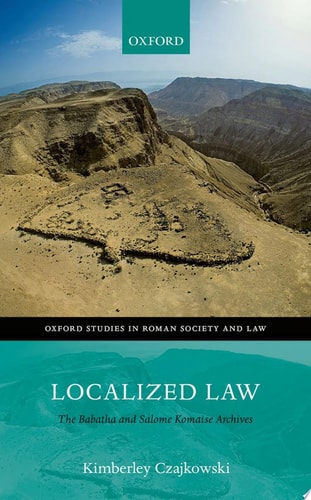
Localized Law
0
0
As an Amazon Associate and affiliate partner, Menrva Books earns from qualifying purchases. Learn more
Author Description
In The Early Second Century Ce, Two Jewish Women, Babatha And Salome Komaise, Lived In The Village Of Maoza On The Southern Coast Of The Dead Sea. This Was First Part Of The Nabataean Kingdom, But Came Under Direct Roman Rule In 106 Ce As Part Of The Province Of Roman Arabia. The Archives These Two Women Left Behind Not Only Provide A Tantalizing Glimpse Into Their Legal Lives And Those Of Their Families, But Also Offer A Vivid Window Onto The Ways In Which The Inhabitants Of This Region Interacted With Their New Rulers And How This Affected The Practice Of Law In This Part Of The Roman Empire. The Papers In These Archives Are Remarkable In Their Legal Diversity, Detailing Babatha And Salome Komaise's Property And Marriages, As Well As Their Disputes. Nabataean, Roman, Greek, And Jewish Legal Elements Are All In Evidence, And Are Often Combined Within A Single Papyrus. As Such, Identifying The Supposed 'operative Law' Of The Documents Has Proven A Highly Contentious Task: Scholarly Advocates Of Each Of These Traditions Have Failed To Reach Any True Consensus And There Remains Division Particularly Between Those Who Argue For A 'roman' Versus A 'jewish' Framework. Taking Its Lead From Recent Advances In The Scholarship Of Roman Law, This Volume Proposes A Change In Focus: Instead Of Attempting To Identify The 'legal System' Behind The Documents, It Seeks Instead To Understand The 'legal Culture' Of The Community That Produced Them. Through A Series Of Case Studies Of The People Involved In The Creation Of The Papyri - The Scribes, Legal Advisors, Local Arbitrators, Roman Judges, And The Litigants Themselves - We Can Build Up A Picture Of The Ways In Which They Variously Perceived And Approached The Legal Transactions, And Thus Of Legal Practice Itself As Being Heavily Influenced By The Particular Agents Involved. This Study Therefore Moves Away From A Systematic Approach Towards An Historical Study Of Ideas, Attitudes, And Perceptions Of Law, Arguing That Concentrati
Menrva's Summary
THE THESIS
How did the inhabitants of the Roman province of Arabia navigate the complex intersection of Nabataean, Roman, Greek, and Jewish legal traditions during the second century CE? Kimberley Czajkowski, a scholar of ancient legal history, challenges the traditional academic search for a singular 'operative law' within the Babatha and Salome Komaise archives. Instead, she proposes a shift toward analyzing the 'legal culture' of the region, arguing that legal practice was shaped more by the specific agents—scribes, litigants, and judges—than by a rigid, overarching imperial system.
THE SCOPE MAP
What You Will Find
- Analysis of the Babatha and Salome Komaise papyri archives from the village of Maoza.
- Examination of legal transactions involving property, marriage, and civil disputes.
- A methodological framework focusing on the roles of scribes, local arbitrators, and Roman judges.
- Historical context regarding the transition from the Nabataean Kingdom to Roman provincial rule in 106 CE.
Scope Limits
- The study does not attempt to define a single, unified legal system for the entire Roman Empire.
- It avoids speculative reconstruction of private lives beyond what is evidenced in the surviving legal documentation.
THE AUTHORITY PERSPECTIVE
Scholars recognize this work as a significant contribution to the study of provincial Roman law, particularly for its move away from rigid systemic categorization. Experts highlight the text as a sophisticated analysis that successfully bridges the gap between legal theory and the lived realities of ancient inhabitants.
Page Count:
288
Publication Date:
2016-01-01
Publisher:
Oxford University Press
ISBN-10:
0191083097
ISBN-13:
9780191083099
History
Jewish History
Legal History
Archaeology
Ancient - Rome
Middle Eastern
Community Tags
Similar Books