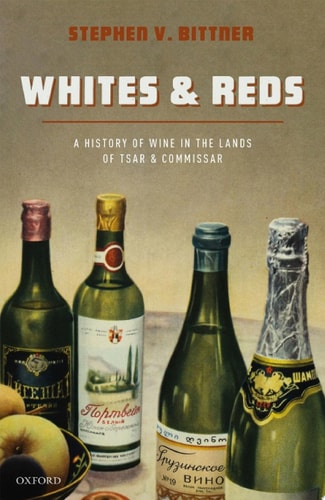
Whites and Reds: A History of Wine in the Lands of Tsar and Commissar
0
0
As an Amazon Associate and affiliate partner, Menrva Books earns from qualifying purchases. Learn more
Author Description
Whites and Reds: A History of Wine in the Lands of Tsar and Commissar tells the story of Russia's encounter with viniculture and winemaking. Rooted in the early-seventeenth century, embraced by Peter the Great, and then magnified many times over by the annexation of the indigenous wine economies and cultures of Georgia, Crimea, and Moldova in the late-eighteenth and early-nineteenth centuries, viniculture and winemaking became an important indicator of Russia's place at the European table. While the Russian Revolution in 1917 left many of the empire's vineyards and wineries in ruins, it did not alter the political and cultural meanings attached to wine. Stalin himself embraced champagne as part of the good life of socialism, and the Soviet Union became a winemaking superpower in its own right, trailing only Spain, Italy, and France in the volume of its production. Whites and Reds illuminates the ideas, controversies, political alliances, technologies, business practices, international networks, and, of course, the growers, vintners, connoisseurs, and consumers who shaped the history of wine in the Russian Empire and the Soviet Union over more than two centuries. Because wine was domesticated by virtue of imperialism, its history reveals many of the instabilities and peculiarities of the Russian and Soviet empires. Over two centuries, the production and consumption patterns of peripheral territories near the Black Sea and in the Caucasus became a hallmark of Russian and Soviet civilizational identity and cultural refinement. Wine in Russia was always more than something to drink.
Menrva's Summary
THE THESIS
This book investigates how the production and consumption of wine served as a critical indicator of Russia's civilizational identity and imperial status from the seventeenth century through the Soviet era. Stephen V. Bittner, a professor of history, utilizes archival research and economic data to trace the development of viniculture across the Russian Empire and the Soviet Union. He argues that wine was not merely a commodity but a political tool used to define Russia's relationship with Europe and to manage its peripheral territories in the Caucasus and Black Sea regions.
THE SCOPE MAP
What You Will Find
- Historical analysis of wine production from the seventeenth century to the late Soviet period.
- Examination of the integration of Georgian, Crimean, and Moldovan wine economies into the Russian imperial framework.
- Discussion of the political and cultural symbolism of wine under both the Tsars and Stalinist socialism.
Scope Limits
- The text does not provide a comprehensive technical manual on winemaking practices or viticulture science.
- It focuses primarily on the geopolitical and cultural history of the industry rather than individual consumer tasting notes.
THE AUTHORITY PERSPECTIVE
Historians and scholars of Russian studies recognize this work as a significant contribution to the study of imperial identity through the lens of material culture. Readers frequently note the academic rigor and the depth of archival detail provided by the author.
Page Count:
263
Publication Date:
2021-01-01
Publisher:
OUP Oxford
ISBN-10:
0191087688
ISBN-13:
9780191087684
History
Russian History
Agriculture
European History
Soviet History
Food History
Cultural History
Community Tags
Similar Books