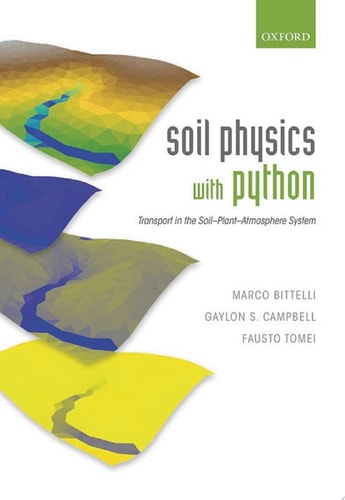
Soil Physics with Python: Transport in the Soil-Plant-Atmosphere System
0
0
As an Amazon Associate and affiliate partner, Menrva Books earns from qualifying purchases. Learn more
Author Description
This innovative study presents concepts and problems in soil physics, and provides solutions using original computer programs. It provides a close examination of physical environments of soil, including an analysis of the movement of heat, water and gases. The authors employ the programming language Python, which is now widely used for numerical problem solving in the sciences. In contrast to the majority of the literature on soil physics, this text focuses on solving, not deriving, differential equations for transport. Using numerical procedures to solve differential equations allows the solution of quite difficult problems with fairly simple mathematical tools. Numerical methods convert differential into algebraic equations, which can be solved using conventional methods of linear algebra. Each chapter introduces a soil physics concept, and proceeds to develop computer programs to solve the equations and illustrate the points made in the discussion. Problems at the end of each chapter help the reader practise using the concepts introduced. The text is suitable for advanced undergraduates, graduates and researchers of soil physics. It employs an open source philosophy where computer code is presented, explained and discussed, and provides the reader with a full understanding of the solutions. Once mastered, the code can be adapted and expanded for the user's own models, fostering further developments. The Python tools provide a simple syntax, Object Oriented Programming techniques, powerful mathematical and numerical tools, and a user friendly environment.
Menrva's Summary
THE THESIS
This text investigates how numerical methods and Python programming can be utilized to solve complex transport equations within the soil-plant-atmosphere system. The authors, Marco Bittelli, Fausto Tomei, and Gaylon S. Campbell, leverage their expertise in soil physics to shift the pedagogical focus from the derivation of differential equations to their practical application through computational modeling. By utilizing Python, the book provides a framework that allows students and researchers to address intricate environmental problems using accessible mathematical tools and open-source code.
THE SCOPE MAP
What You Will Find
- Numerical procedures for solving differential equations related to heat, water, and gas movement in soil.
- Practical implementation of Object Oriented Programming techniques for scientific modeling.
- End-of-chapter problem sets designed to reinforce conceptual understanding and coding proficiency.
Scope Limits
- The text does not focus on the theoretical derivation of differential equations, prioritizing numerical solution methods instead.
THE AUTHORITY PERSPECTIVE
Experts and academics identify this work as a practical resource for bridging the gap between theoretical soil physics and computational application. Readers frequently note that the focus on actionable Python code makes it a highly effective tool for advanced students and researchers looking to model environmental systems.
Page Count:
432
Publication Date:
2015-01-01
Publisher:
OUP Oxford
ISBN-10:
0191505595
ISBN-13:
9780191505591
Science
Agriculture
Soil physics
Trades & Technology
Python Programming
Earth Sciences
Python computer program language
Numerical analysis
Earth Science
Community Tags
Similar Books