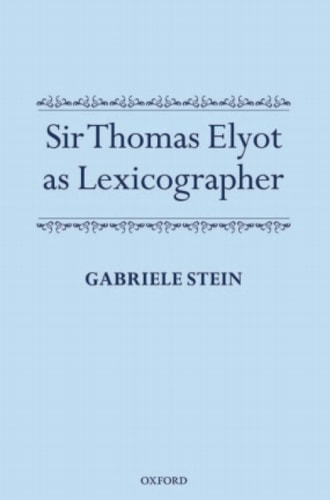
Sir Thomas Elyot as Lexicographer
0
0
As an Amazon Associate and affiliate partner, Menrva Books earns from qualifying purchases. Learn more
Author Description
Sir Thomas Elyot's Latin-English dictionary, published in 1538, became the leading work of its kind in England. Gabriele Stein describes this pioneering work, exploring its inner structure and workings, its impact on contemporary scholarship, and its later influence. The author opens with an account of Elyots life and publications. Sir Thomas Elyot (c. 1490-1546) was a humanist scholar and intellectual friend of Sir Thomas More. He was employed by Thomas Cromwell in diplomatic and official capacities that did more to impoverish than enrich him, and he sought to increase his income with writing. His treatise on moral philosophy, The Boke named the Governour, was published in 1531, and dedicated to Henry VIII. His popular treatise on medicine, The Castell of Helth, published some years later, went through seventeen editions. Professor Stein then considers how and why Elyot decided to compile a Latin-English dictionary. She looks at the guiding principles, the organization he devised, and the authors and texts he used as sources. She examines the books importance for the historical study of English, noting the lexical regionalisms and items of vulgar usage in the Promptuorum parvulorum and the dictionaries of Palsgrave and Elyot before discussing Elyots linking of lemma and gloss, and use of generic reference points. She explains how Elyot translated and defined the Latin headwords and compares his practice with his predecessors. The author ends with a detailed assessment of Elyots impact on sixteenth- and seventeenth-century dictionaries and his place in Renaissance lexicography. Her exploration of the work of an outstanding sixteenth-century scholar will interest historians of the English language, lexicography, and the intellectual climate of Tudor England.
Menrva's Summary
THE THESIS
This work investigates the development, methodology, and lasting influence of Sir Thomas Elyot’s 1538 Latin-English dictionary within the context of Renaissance scholarship. Gabriele G. Stein, a professor specializing in linguistics, provides a comprehensive analysis of Elyot’s life and his transition from a diplomat and humanist to a lexicographer. By examining the structural choices and source materials utilized by Elyot, the author argues that his dictionary served as a foundational text that shaped the evolution of the English language during the sixteenth century.
THE SCOPE MAP
What You Will Find
- A biographical overview of Sir Thomas Elyot’s career and intellectual circle.
- An analysis of the lexicographical principles and organizational structure of the 1538 dictionary.
- A comparative study of Elyot’s translation practices against his contemporaries such as Palsgrave.
- An assessment of the dictionary’s influence on subsequent seventeenth-century lexicography.
Scope Limits
- The text does not provide a complete biography of Elyot’s political career beyond its impact on his writing.
- It does not offer a comprehensive history of all Tudor-era dictionaries, focusing primarily on Elyot’s specific contributions.
THE AUTHORITY PERSPECTIVE
Scholars and historians of the English language recognize this work as a definitive study on the mechanics of early modern dictionary compilation. Experts frequently highlight the text for its meticulous archival research and its clear articulation of how Elyot’s work bridged the gap between classical Latin and vernacular English usage.
Page Count:
448
Publication Date:
2014-01-01
Publisher:
OUP Oxford
ISBN-10:
0191506184
ISBN-13:
9780191506185
History
Biography
Latin Language
English & College Success
Linguistics
Tudor England
English
Lexicography
Community Tags
Similar Books