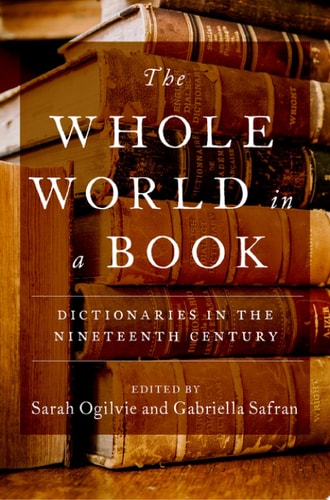
The Whole World in a Book: Dictionaries in the Nineteenth Century
0
0
As an Amazon Associate and affiliate partner, Menrva Books earns from qualifying purchases. Learn more
Author Description
Nineteenth-century readers had an appetite for books so big they seemed to contain the whole world: immense novels, series of novels, encyclopaedias. Especially in Eurasia and North America, especially among the middle and upper classes, people had the space, time, and energy for very long books. More than other multi-volume nineteenth-century collections, the dictionaries, or their descendants of the same name, remain with us in the twenty-first century. Online or on paper, people still consult Oxford for British English, Webster for American, Grimm for German, Littré for French, Dahl for Russian. Even in spaces whose literary languages already had long philological and lexicographic traditions-Chinese, Japanese, Arabic, Persian, Greek, Latin-the burgeoning imperialisms and nationalisms of the nineteenth century generated new dictionaries.The Whole World in a Book explores a period in which globalization, industrialization, and social mobility were changing language in unimaginable ways. Newly automated technologies and systems of communication expanded the international reach of dictionaries, while rising literacy rates, book consumption, and advertising led to their unprecedented popularization. Dictionaries in the nineteenth century became more than dictionaries: they were battlefields between prestige languages and lower-status dialects; national icons celebrating the language and literature of the nation-state; and sites of innovative authorship where middle and lower classes, volunteers, women, colonial subjects, the deaf, and missionaries joined the ranks of educated white men in defining how people communicated and understood the world around them.In this volume, eighteen of the world's leading scholars investigate these lexicographers asking how the world within which they lived supported their projects? What did language itself mean for them? What goals did they try to accomplish in their dictionaries?
Menrva's Summary
THE THESIS
This volume investigates how the nineteenth-century dictionary evolved from a mere reference tool into a cultural, political, and social instrument that reflected the era's rapid globalization and nationalism. Editors Gabriella Safran and Sarah Ogilvie curate a collection of essays from eighteen international scholars who examine the socio-historical conditions surrounding lexicographical projects. By analyzing the intersection of industrialization, literacy, and imperial expansion, the contributors argue that dictionaries served as battlegrounds for national identity and social status.
THE SCOPE MAP
What You Will Find
- Comparative analysis of major lexicographical projects including the Oxford, Webster, Grimm, and Dahl dictionaries.
- Examination of the role of non-traditional contributors such as women, colonial subjects, and the deaf in language standardization.
- Historical context regarding the impact of rising literacy rates and automated printing technologies on book consumption.
Scope Limits
- The text focuses primarily on the nineteenth century and does not provide a comprehensive history of lexicography from antiquity to the present.
- It does not offer a technical manual for modern dictionary compilation or linguistic theory.
THE AUTHORITY PERSPECTIVE
Scholars and historians of the nineteenth century identify this work as a significant contribution to the study of how language and national identity were codified during the industrial era. Readers frequently note the academic density of the prose, which provides a rigorous examination of the social forces that shaped modern reference works.
Page Count:
349
Publication Date:
2019-01-01
Publisher:
Oxford University Press
ISBN-10:
0190913215
ISBN-13:
9780190913212
History
Nineteenth century
English & College Success
Lexicography
English
Reference
Linguistics
Community Tags
Similar Books