Writing a War of Words: Andrew Clark and the Search for Meaning in World War One
0
0
As an Amazon Associate and affiliate partner, Menrva Books earns from qualifying purchases. Learn more
Author Description
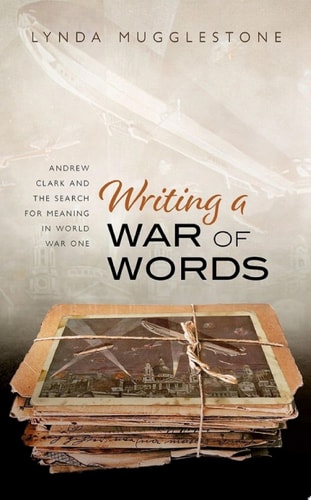
Writing a War of Words is the first exploration of the war-time quest by Andrew Clark - a writer, historian, and volunteer on the first edition of the Oxford English Dictionary - to document changes in the English language from the start of the First World War up to 1919. Clark's unique series of lexical scrapbooks, replete with clippings, annotations, and real-time definitions, reveals a desire to put living language history to the fore, and to create a record of often fleeting popular use. The rise of trench warfare, the Zeppelinophobia of total war, and descriptions of shellshock (and raid shock on the Home Front) all drew his attentive gaze. The archive includes examples from a range of sources, such as advertising, newspapers, and letters from the Front, as well as documenting social issues such as the shifting forms of representation as women 'did their bit' on the Home Front. Lynda's Mugglestone's fascinating investigation of this valuable archive reassesses the conventional accounts of language history during this period, recuperates Clark himself as another 'forgotten lexicographer', challenges the received wisdom on the inexpressibilities of war, and examines the role of language as an interdisciplinary lens on history.
Menrva's Summary
THE THESIS
How did the linguistic landscape of the First World War reflect the social and psychological shifts of a nation in total war? Lynda Mugglestone, a professor of the history of English, examines the extensive lexical scrapbooks compiled by Andrew Clark, a volunteer for the Oxford English Dictionary, to argue that language serves as a primary interdisciplinary lens for understanding the conflict. By analyzing Clark's meticulous documentation of evolving terminology, Mugglestone demonstrates that the war did not render language inexpressible, but rather forced a rapid, creative adaptation of vocabulary to capture new realities.
THE SCOPE MAP
What You Will Find
- Analysis of Andrew Clark's personal lexical scrapbooks from 1914 to 1919.
- Examination of linguistic shifts related to trench warfare, home front social changes, and psychological trauma.
- Methodology for using archival clippings and real-time definitions as historical evidence.
Scope Limits
- The study is primarily focused on the British experience and the English language as documented by Clark.
- It does not provide a comprehensive military history of the war, focusing instead on the lexicographical and social record.
THE AUTHORITY PERSPECTIVE
Scholars and historians recognize this work as a significant contribution to both lexicography and the social history of the First World War. Readers frequently note the academic rigor of the prose, which effectively balances linguistic analysis with the personal narrative of a forgotten historical figure.
Page Count:
361
Publication Date:
2021-01-01
Publisher:
OUP Oxford
ISBN-10:
0192642782
ISBN-13:
9780192642783
History
Biography
Lexicography
Social History
English
World War
Linguistics
English & College Success
Community Tags
Similar Books