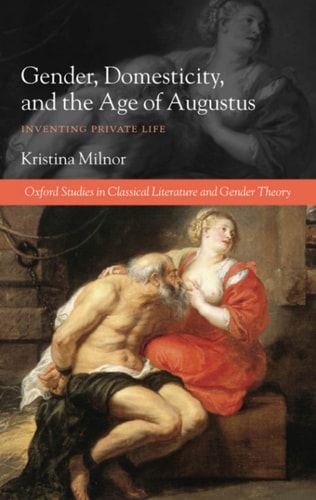
Gender, Domesticity, and the Age of Augustus: Inventing Private Life
0
0
As an Amazon Associate and affiliate partner, Menrva Books earns from qualifying purchases. Learn more
Author Description
The age of Augustus has long been recognized as a time when the Roman state put a new emphasis on `traditional' feminine domestic ideals, yet at the same time gave real public prominence to certain women in their roles as wives, mothers, sisters, and daughters. Kristina Milnor takes up a series of texts and their contexts in order to explore this paradox. Through an examination of authors such as Vitruvius, Livy, Valerius Maximus, Seneca the Elder, and Columella, she argues that female domesticity was both a principle and a problem for early imperial writers, as they sought to construct a new definition of who and what constituted Roman public life.
Menrva's Summary
THE THESIS
This book investigates how early imperial Roman writers navigated the paradox of promoting traditional feminine domesticity while simultaneously granting public prominence to women in political and social roles. Kristina Milnor, a scholar of classical literature, examines a range of texts from the Augustan and early imperial periods to demonstrate how the concept of the private sphere was actively constructed to define the boundaries of Roman public life. By analyzing the works of authors such as Vitruvius, Livy, and Seneca the Elder, she argues that the domestic woman served as a critical, albeit problematic, figure in the reconfiguration of Roman identity during a time of significant political transition.
THE SCOPE MAP
What You Will Find
- Analysis of primary texts by Vitruvius, Livy, Valerius Maximus, Seneca the Elder, and Columella
- A framework for understanding the intersection of gender, domestic space, and imperial politics
- Examination of the rhetorical strategies used to define 'private life' in the Roman context
Scope Limits
- The study focuses primarily on literary and rhetorical constructions rather than archaeological or material evidence of domestic life
- The analysis is restricted to the Augustan and early imperial periods of Roman history
THE AUTHORITY PERSPECTIVE
Scholars in the field of classical studies frequently cite this work for its nuanced approach to the intersection of gender theory and Roman literature. Experts highlight the text as a significant contribution to understanding how imperial ideology utilized domestic ideals to shape public discourse.
Page Count:
372
Publication Date:
2008-01-01
Publisher:
Oxford University Press, USA
ISBN-10:
0191515647
ISBN-13:
9780191515644
History
English
Roman History
English & College Success
Ancient History
Literary Criticism
Gender Studies
Community Tags
Similar Books