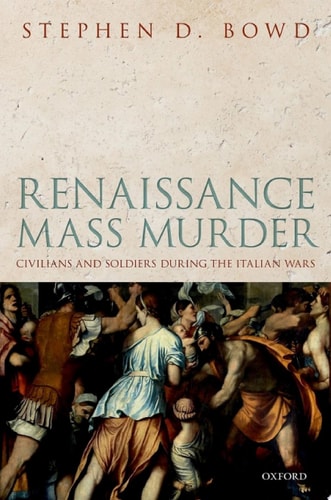
Renaissance Mass Murder: Civilians and Soldiers During the Italian Wars
0
0
As an Amazon Associate and affiliate partner, Menrva Books earns from qualifying purchases. Learn more
Author Description
Renaissance Mass Murder explores the devastating impact of war on the men and women of the Renaissance. In contrast to the picture of balance and harmony usually associated with the Renaissance, it uncovers in forensic detail a world in which sacks of Italian cities and massacres of civilians at the hands of French, German, Spanish, Swiss, and Italian troops were regular occurrences. The arguments presented are based on a wealth of evidence - histories and chronicles, poetry and paintings, sculpture and other objects - which together provide a new and startling history of sixteenth-century Italy and a social history of the Italian Wars. It outlines how massacres happened, how princes, soldiers, lawyers, and writers justified and explained such events, and how they were represented in contemporary culture. On this basis, Renaissance Mass Murder reconstructs the terrifying individual experiences of civilians in the face of war and in doing so offers a story of human tragedy which redresses the balance of the history of the Italian Wars, and of Renaissance warfare, in favour of the civilian and away from the din of battle. This volume also places mass murder in a broader historical context and challenges claims that such violence was unusual or in decline in early modern Europe. Finally, it shows that women often suffered disproportionately from this violence and that immunity for them, as for their children, was often partially developed or poorly respected.
Menrva's Summary
THE THESIS
This book investigates the frequency and justification of civilian massacres during the Italian Wars, challenging the perception of the Renaissance as an era defined solely by harmony and cultural achievement. Stephen D. Bowd, a specialist in Renaissance history, utilizes a diverse array of primary sources—including chronicles, legal documents, poetry, and visual arts—to construct a social history of sixteenth-century warfare. He argues that mass violence against non-combatants was a systemic feature of the period rather than an anomaly, and he examines the mechanisms through which such atrocities were rationalized by contemporary authorities.
THE SCOPE MAP
What You Will Find
- Analysis of the impact of French, German, Spanish, Swiss, and Italian military campaigns on civilian populations.
- Examination of the legal and cultural frameworks used to justify or explain mass violence.
- Evidence derived from contemporary chronicles, visual art, sculpture, and literary accounts.
- A specific focus on the disproportionate violence experienced by women and children during city sacks.
Scope Limits
- The study is geographically confined to the Italian peninsula during the sixteenth century.
- It does not provide a comprehensive military history of troop movements or tactical battlefield maneuvers.
THE AUTHORITY PERSPECTIVE
Historians and scholars of early modern Europe recognize this work as a significant contribution to the social history of warfare, noting its success in shifting the focus from military strategy to the civilian experience. Readers frequently highlight the author's meticulous use of primary sources to dismantle long-standing myths regarding the nature of Renaissance violence.
Page Count:
302
Publication Date:
2018-01-01
Publisher:
OUP Oxford
ISBN-10:
0192568795
ISBN-13:
9780192568793
History
Military History
Europe
Social History
European History
Politics & Government
Italian History