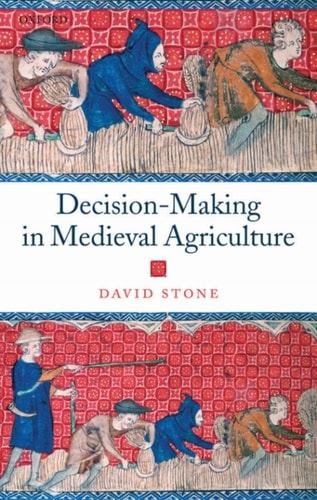
Decision-Making in Medieval Agriculture
0
0
As an Amazon Associate and affiliate partner, Menrva Books earns from qualifying purchases. Learn more
Author Description
This fascinating and important book uses a wealth of contemporary sources to reconstruct the mental world of medieval farmers and, by doing so, argues that these key figures in the Middle Ages have been unfairly stereotyped. David Stone overturns the traditional view of medieval countrymen as economically backward and instead reveals that agricultural decision-making was as rational in the fouteenth century as in modern times. Investigating agricultural mentalities first at a local level and then for England as a whole, Dr Stone argues that human action shaped the course of the rural economy to a much greater extent than has hitherto been appreciated, and challenges the commonly held view that the medieval period was dominated by ecological and economic crises. Focusing in particular on responses to commercial forces and the adoption of agricultural technology, this book has significant implications for our understanding of agricultural development throughout the last thousand years.
Menrva's Summary
THE THESIS
This book investigates whether medieval farmers operated with rational economic decision-making processes rather than being driven solely by ecological constraints or traditional stereotypes. Dr. David Stone, a historian specializing in medieval rural economies, utilizes extensive contemporary source material to reconstruct the mentalities of fourteenth-century agriculturalists. He argues that these individuals actively shaped the rural economy through calculated responses to market forces and technological innovation, challenging the long-standing academic narrative of medieval economic stagnation.
THE SCOPE MAP
What You Will Find
- Analysis of fourteenth-century agricultural decision-making processes.
- Examination of responses to commercial market forces and technological adoption.
- Comparative study of local agricultural mentalities versus national economic trends.
Scope Limits
- The study is primarily focused on the English rural economy.
- The analysis does not extend to non-European agricultural systems or post-medieval developments.
THE AUTHORITY PERSPECTIVE
Historians and scholars of the medieval period recognize this work as a significant contribution to the field for its rigorous use of primary sources to challenge traditional economic historiography. Readers frequently note the academic density of the prose, which provides a detailed and evidence-based counter-argument to the view of medieval farmers as economically passive.
Page Count:
324
Publication Date:
2005-01-01
Publisher:
OUP Oxford
ISBN-10:
0191514357
ISBN-13:
9780191514357
History
England
European History
Economic History
Community Tags
Similar Books