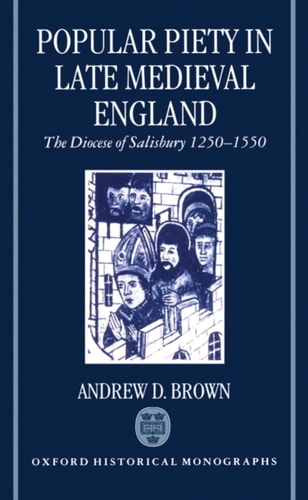
Popular Piety in Late Medieval England: The Diocese of Salisbury 1250-1550
0
0
As an Amazon Associate and affiliate partner, Menrva Books earns from qualifying purchases. Learn more
Author Description
Andrew Brown explores lay piety in its contexts of landscape, society, and the church, and examines the many different issues and activities which were of contemporary importance, such as the religious guilds, charity, and heresy. He shows how the regional variations in social and economic structure affected parish life, and concluces with an important assessment of the reception of the Reformation in the diocese. This is the first scholarly study of the lay religion of this region, and its broad chronological range of and meticulously researched local focus offer illuminating insights into medieval piety over the centuries.
Menrva's Summary
THE THESIS
This study investigates the nature and evolution of lay piety within the Diocese of Salisbury between 1250 and 1550 to determine how regional social and economic structures influenced religious practice. Andrew D. Brown utilizes extensive archival research to examine the intersection of landscape, parish life, and ecclesiastical authority. By focusing on a specific geographic region over three centuries, the author provides a framework for understanding how local communities engaged with religious guilds, charity, and the eventual transition of the Reformation.
THE SCOPE MAP
What You Will Find
- Analysis of religious guilds and charitable organizations within the Diocese of Salisbury.
- Examination of the impact of regional economic and social structures on parish life.
- Assessment of the reception and implementation of the Reformation at the local level.
- Historical investigation into the prevalence and management of heresy in late medieval England.
THE AUTHORITY PERSPECTIVE
Experts recognize this work as a foundational regional study that bridges the gap between broad ecclesiastical history and local social practice. Scholars frequently cite the text for its meticulous archival methodology and its nuanced treatment of the pre-Reformation religious landscape.
Page Count:
314
Publication Date:
1995-05-11
Publisher:
Clarendon Press
ISBN-10:
019820521X
ISBN-13:
9780198205210
History
Great Britain
England
European History
Catholics england
Religious History
Community Tags
Similar Books