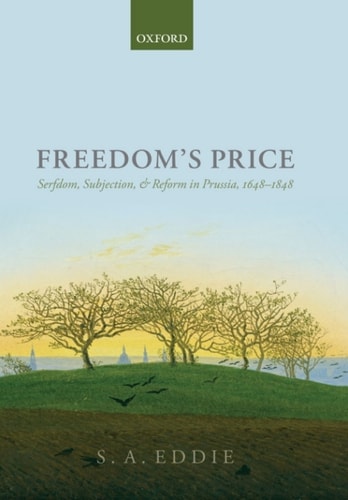
Freedom's Price: Serfdom, Subjection, and Reform in Prussia, 1648-1848
0
0
As an Amazon Associate and affiliate partner, Menrva Books earns from qualifying purchases. Learn more
Author Description
It is usually claimed that serfs were oppressed and unfree, but is this assumption true? Freedom's Price, building on a new reading of archival material, attempts a fundamental re-appraisal of the continuing orthodoxy that a 'serf' economy embodied peasant exploitation. It reveals that, in fact, Prussian 'subject' peasants fared much better than their 'free' neighbours; they had mutual rights and obligations with nobles and the state. In this volume, Sean Eddie seeks to establish the true 'price of freedom' paid by the peasants both in the so-called Second Serfdom around 1650 and in the enfranchisement of 1807-21. Far from representing further exploitation, the peasants drove a hard bargain, and many nobles subsequently fared worse than their tenants; subjection was abolished and land ownership was transferred from noble to peasant. Capital was therefore at the centre of the pre-capitalist economy, and the growing economic polarization of society owed more to the peasants' access to capital than to noble exploitation. By locating Prussian serfdom and reforms in a pan-European context, and within debates about the nature of economic development, feudalism, and capitalism, Freedom's Price targets a wider audience of early modern and modern European historians, economic historians, and interested general readers.
Menrva's Summary
THE THESIS
This work investigates whether the traditional characterization of Prussian serfdom as a system of inherent peasant exploitation is historically accurate. Author S. A. Eddie utilizes archival research to challenge the orthodoxy surrounding the 'Second Serfdom' and the subsequent reforms of 1807-1821. The text argues that the relationship between peasants, nobles, and the state was defined by mutual obligations and that access to capital, rather than simple exploitation, drove economic outcomes during this period.
THE SCOPE MAP
What You Will Find
- Analysis of Prussian agrarian structures between 1648 and 1848
- Examination of the economic transition from feudalism to capitalism
- Comparative study of peasant and noble economic standing
Scope Limits
- The study is geographically confined to Prussia
- It does not provide a comprehensive history of all European serfdom systems
THE AUTHORITY PERSPECTIVE
Historians and scholars of economic development frequently cite this work for its revisionist approach to Prussian agrarian history. The text is noted for its dense engagement with archival data and its contribution to the ongoing debate regarding the transition to capitalist economies.
Page Count:
400
Publication Date:
2013-01-01
Publisher:
OUP Oxford
ISBN-10:
0191639753
ISBN-13:
9780191639753
History
Feudalism
European History
Social History
Germany history
Economic History
Community Tags
Other Editions(2)

Similar Books