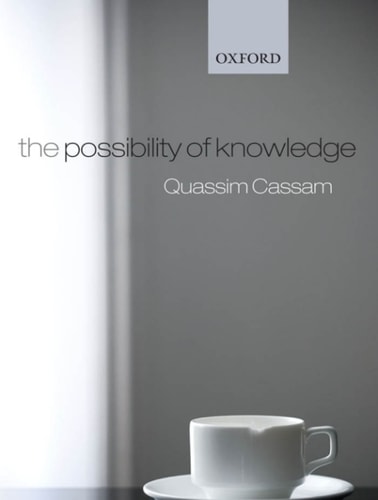
The Possibility of Knowledge
0
0
As an Amazon Associate and affiliate partner, Menrva Books earns from qualifying purchases. Learn more
Author Description
How is knowledge of the external world possible? How is knowledge of other minds possible? How is a priori knowledge possible? These are all examples of how-possible questions in epistemology. Quassim Cassam explains how such questions arise and how they should be answered. In general, we ask how knowledge, or knowledge of some specific kind, is possible when we encounter obstacles to its existence or acquisition. So the question is: how is knowledge possible given the various factors that make it look impossible? A satisfactory answer to such a question will therefore need to do several different things. In essence, explaining how a particular kind of knowledge is possible is a matter of identifying ways of acquiring it, overcoming or dissipating obstacles to its acquisition, and figuring out what makes it possible to acquire it. To respond to a how-possible question in this way is to go in for what might be called a 'multi-levels' approach. The aim of this book is to develop and defend this approach. The first two chapters bring out its advantages and explain why it works better than more familiar 'transcendental' approaches to explaining how knowledge is possible. The remaining chapters use the multi-levels framework to explain how perceptual knowledge is possible, how it is possible to know of the existence of minds other than one's own and how a priori knowledge is possible.
Menrva's Summary
THE THESIS
This book investigates the fundamental epistemological question of how knowledge of the external world, other minds, and a priori truths is possible despite apparent obstacles to their acquisition. Quassim Cassam, a professor of philosophy, argues that traditional transcendental approaches are insufficient for addressing these inquiries. He proposes a 'multi-levels' framework that identifies specific acquisition methods and resolves the logical barriers that suggest such knowledge might be unattainable.
THE SCOPE MAP
What You Will Find
- A critique of traditional transcendental arguments in epistemology
- The introduction of a multi-levels methodology for addressing how-possible questions
- Applications of the framework to perceptual knowledge and knowledge of other minds
- Analysis of the conditions required for a priori knowledge
Scope Limits
- The text does not provide an exhaustive history of all epistemological theories
- It focuses primarily on the methodology of answering how-possible questions rather than providing a comprehensive survey of all branches of philosophy
THE AUTHORITY PERSPECTIVE
Philosophical scholars recognize this work as a significant contribution to contemporary epistemology for its clear articulation of the multi-levels approach. Readers frequently note the academic density of the prose, which is intended for students and professionals familiar with analytic philosophy.
Page Count:
256
Publication Date:
2007-01-01
Publisher:
Clarendon Press
ISBN-10:
0191526002
ISBN-13:
9780191526008
Philosophy
Non-Fiction
Epistemology
Knowledge Theory
Metaphysics
Community Tags
Other Editions(3)

Similar Books