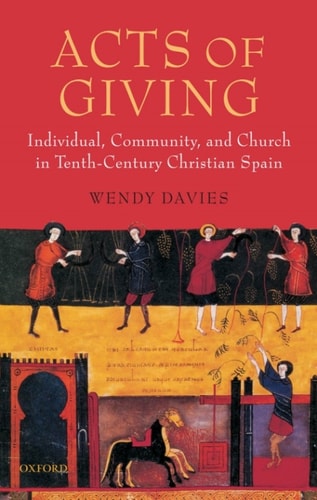
Acts of Giving: Individual, Community, and Church in Tenth-Century Christian Spain
0
0
As an Amazon Associate and affiliate partner, Menrva Books earns from qualifying purchases. Learn more
Author Description
Acts of Giving examines the issues surrounding donation - the giving of property, usually landed property - in northern 'Christian' Spain in the tenth century, when written texts became very plentiful, allowing us to glimpse the working of local society. Wendy Davies explores who gives and who receives; what is given; reasons for giving; and the place of giving within the complex of social and economic relationships in society as a whole. People gave land for all kinds of reasons - because they were forced to do so, to meet debts or pay fines; because they wanted to gain material benefits in life, or to secure support in the short term or in old age. Giving pro anima, for the sake of the soul, was relatively limited; and gifts were made to lay persons as well as to the church. Family interests were strongly sustained across the tenth century and did not dwindle; family land was split and re-assembled, not fragmented. The gender and status of donors are key themes, along with commemoration: more men than women took steps to memorialize, in contrast to some parts of western Europe, and more aristocrats than peasants, which is less of a contrast. Donation as a type of transaction is also examined, as well as the insights into status afforded by the language and form of the records. Buying and selling, giving and receiving continued in the tenth-century as it had for centuries. However this period saw the volume of peasant donation to the church increasing enormously. It was this which set the conditions for substantial social and economic change.
Menrva's Summary
THE THESIS
This work investigates the social and economic motivations behind property donation in tenth-century northern Christian Spain. Wendy Davies, a historian specializing in early medieval Europe, utilizes an extensive corpus of written records from the period to analyze the dynamics of land transfer. She argues that while religious motivations existed, the primary drivers for donation were often pragmatic, involving debt settlement, social security, and the maintenance of family interests.
THE SCOPE MAP
What You Will Find
- Analysis of land donation patterns among peasants and aristocrats
- Examination of gender and status in property transactions
- Study of the relationship between lay society and the church
- Investigation into the language and legal form of tenth-century records
Scope Limits
- The study is geographically restricted to northern Christian Spain
- The analysis focuses primarily on the tenth century and does not provide a comprehensive survey of the entire medieval period
THE AUTHORITY PERSPECTIVE
Scholars recognize this text as a rigorous examination of medieval social structures through the lens of archival evidence. Readers frequently note the academic density of the prose and the author's meticulous attention to the nuances of property records.
Page Count:
240
Publication Date:
2007-01-01
Publisher:
Oxford University Press
ISBN-10:
0191536210
ISBN-13:
9780191536212
History
Endowments
Gifts
European History
Social History
Christianity
Social Life
Spain
Economic History
Community Tags
Similar Books