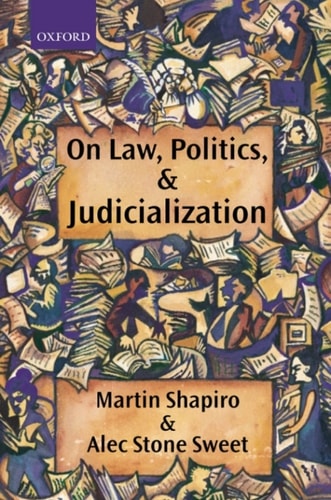
On Law, Politics, and Judicialization
0
0
As an Amazon Associate and affiliate partner, Menrva Books earns from qualifying purchases. Learn more
Author Description
Across the globe, the domain of the litigator and the judge has radically expanded, making it increasingly difficult for those who study comparative and international politics, public policy and regulation, or the evolution of new modes of governance to avoid encountering a great deal of law and courts. In On Law, Politics, and Judicialization, two of the world's leading political scientists present the best of their research, focusing on how to build and test a social science of law and courts. The opening chapter features Shapiro's classic 'Political Jurisprudence,' and Stone Sweet's 'Judicialization and the Construction of Governance,' pieces that critically redefined research agendas on the politics of law and judging. Subsequent chapters take up diverse themes: the strategic contexts of litigation and judging; the discursive foundations of judicial power; the social logic of precedent and appeal; the networking of legal elites; the lawmaking dynamics of rights adjudication; the success and diffusion of constitutional review; the reciprocal impact of courts and legislatures; the globalization of private law; methods, hypothesis-testing, and prediction in comparative law; and the sources and consequences of the creeping 'judicialization of politics' around the world. Chosen empirical settings include the United States, the GATT-WTO, France and Germany, Imperial China and Islam, the European Union, and the transnational world of the Lex Mercatoria. Written for a broad, scholarly audience, the book is also recommended for use in graduate and advanced undergraduate courses in law and the social sciences.
Menrva's Summary
THE THESIS
This volume investigates the mechanisms and consequences of the global expansion of judicial power, known as the judicialization of politics. The authors, Alec Stone Sweet and Martin Shapiro, leverage their extensive expertise in political science to construct a rigorous social science framework for analyzing courts. By synthesizing foundational theories with empirical research, they provide a systematic approach to understanding how legal institutions influence governance and policy outcomes across diverse political systems.
THE SCOPE MAP
What You Will Find
- Theoretical frameworks for political jurisprudence and judicialization.
- Analysis of strategic litigation, precedent, and the networking of legal elites.
- Comparative studies covering the United States, the European Union, France, Germany, and international bodies like the WTO.
Scope Limits
- The text focuses primarily on political and institutional analysis rather than the technical nuances of specific national legal codes.
- It does not provide a comprehensive history of every global legal system, focusing instead on specific case studies that illustrate broader trends.
THE AUTHORITY PERSPECTIVE
Experts recognize this collection as a foundational resource for scholars and students examining the intersection of law and political science. Readers frequently note the academic density of the prose, which is tailored for graduate-level research and advanced theoretical inquiry.
Page Count:
280
Publication Date:
2002-01-01
Publisher:
Oxford University Press
ISBN-10:
0191531375
ISBN-13:
9780191531378
Comparative Politics
Judicial Power
Political Aspects
Governance
Law
Public Policy