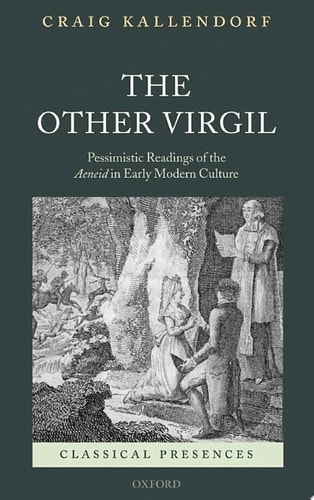
The Other Virgil: 'Pessimistic' Readings of the Aeneid in Early Modern Culture
0
0
As an Amazon Associate and affiliate partner, Menrva Books earns from qualifying purchases. Learn more
Author Description
The Other Virgil tells the story of how a classic like the Aeneid can say different things to different people. As a school text it was generally taught to support the values and ideals of a succession of postclassical societies, but between 1500 and 1800 a number of unusually sensitive readers responded to cues in the text that call into question what the poem appears to be supporting. This book focuses on the literary works written by these readers, to show how they used the Aeneid as a model for poems that probed and challenged the dominant values of their society, just as Virgil had done centuries before. Some of these poems are not as well known today as they should be, but others, like Milton's Paradise Lost and Shakespeare's The Tempest, are; in the latter case, the poems can be understood in new ways once their relationship to the 'other Virgil' is made clear.
Menrva's Summary
THE THESIS
This book investigates how early modern readers interpreted the Aeneid as a subversive text that challenged, rather than merely supported, the dominant political and social values of their time. Craig Kallendorf, a scholar of classical reception, utilizes a historical framework to examine how writers between 1500 and 1800 identified pessimistic or critical cues within Virgil's epic. By analyzing the literary output of these readers, the author argues that the Aeneid functioned as a complex model for questioning authority, influencing major works of the period.
THE SCOPE MAP
What You Will Find
- Analysis of the reception of the Aeneid from 1500 to 1800
- Examination of literary works by Milton and Shakespeare in relation to Virgilian subversion
- Discussion of the tension between pedagogical use and critical interpretation of classical texts
Scope Limits
- Does not provide a comprehensive history of all Virgil translations
- Focuses primarily on Western European literary responses rather than global reception
THE AUTHORITY PERSPECTIVE
Scholars recognize this work as a significant contribution to the field of classical reception studies, particularly for its focus on the 'pessimistic' reading tradition. Experts highlight the book's ability to bridge the gap between classical antiquity and early modern literature with academic rigor.
Page Count:
267
Publication Date:
2007-01-01
Publisher:
OUP Oxford
ISBN-10:
0191607398
ISBN-13:
9780191607394
History of Ideas
English & College Success
Literary Criticism
English
Renaissance
Community Tags
Similar Books