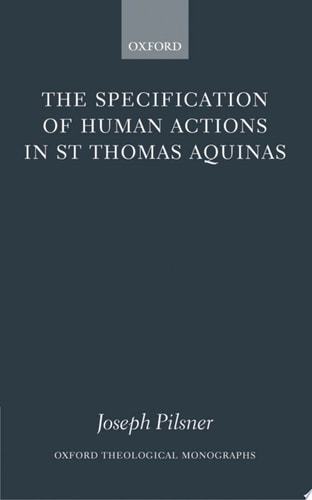
The Specification of Human Actions in St Thomas Aquinas
0
0
As an Amazon Associate and affiliate partner, Menrva Books earns from qualifying purchases. Learn more
Author Description
Thomas Aquinas believed that human actions have species, such as theft or almsgiving. A problem arises, however, concerning his teaching on how such moral kinds are determined. Aquinas uses five different terms - end, object, matter, circumstance, and motive - to identify what gives species to human actions. Although similarities in meaning can be discerned between certain of these terms, apparent differences between others make it difficult to grasp how all five could refer to what specifies human actions. Joseph Pilsner examines and compares Aquinas's understanding of these five terms to see if a consistent account of his teaching on specification can be proposed.
Menrva's Summary
THE THESIS
This work investigates how Thomas Aquinas determines the moral species of human actions through his use of five distinct, yet potentially overlapping, terms. Joseph Pilsner, a scholar of medieval philosophy, analyzes the conceptual framework Aquinas employs to categorize actions such as theft or almsgiving. By examining the roles of end, object, matter, circumstance, and motive, the author seeks to reconcile apparent inconsistencies in Aquinas's moral theory to provide a unified interpretation of his teaching on specification.
THE SCOPE MAP
What You Will Find
- A comparative analysis of five key terms: end, object, matter, circumstance, and motive.
- An examination of the structural logic behind moral categorization in Thomistic ethics.
- A synthesis of Aquinas's scattered references into a coherent philosophical account.
Scope Limits
- The study does not provide a general introduction to Thomistic ethics for lay readers.
- The analysis is restricted to the specific problem of moral specification rather than Aquinas's broader metaphysical or political theories.
THE AUTHORITY PERSPECTIVE
Scholars and students of medieval philosophy frequently cite this text as a rigorous, specialized examination of a complex problem in Thomistic moral theology. Experts highlight the book's success in navigating the technical nuances of Aquinas's terminology, making it a valuable resource for those engaged in advanced ethical research.
Page Count:
286
Publication Date:
2006-01-01
Publisher:
OUP Oxford
ISBN-10:
0191608696
ISBN-13:
9780191608698
Philosophy
Religion
Ethics
Theology
Thomas Aquinas