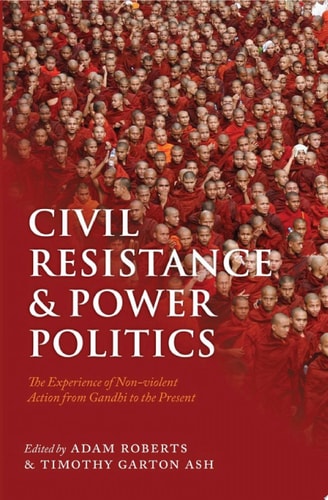
Civil Resistance and Power Politics: The Experience of Non-violent Action from Gandhi to the Present
0
0
As an Amazon Associate and affiliate partner, Menrva Books earns from qualifying purchases. Learn more
Author Description
This widely-praised book identified peaceful struggle as a key phenomenon in international politics a year before the revolutions in Tunisia and Egypt confirmed its central argument. Civil resistance - non-violent action against such challenges as dictatorial rule, racial discrimination and foreign military occupation - is a significant but inadequately understood feature of world politics. Especially through the peaceful revolutions of 1989, and the developments in the Arab world since December 2010, it has helped to shape the world we live in. Civil Resistance and Power Politics covers most of the leading cases, including the actions master-minded by Gandhi, the US civil rights struggle in the 1960s, the Islamic revolution in Iran in 1979, the 'people power' revolt in the Philippines in the 1980s, the campaigns against apartheid in South Africa, the various movements contributing to the collapse of the Soviet Bloc in 1989-91, and, in this century, the 'colour revolutions' in Georgia and Ukraine. The chapters, written by leading experts, are richly descriptive and analytically rigorous. This book addresses the complex interrelationship between civil resistance and other dimensions of power. It explores the question of whether civil resistance should be seen as potentially replacing violence completely, or as a phenomenon that operates in conjunction with, and modification of, power politics. It looks at cases where campaigns were repressed, including China in 1989 and Burma in 2007. It notes that in several instances, including Northern Ireland, Kosovo and, Georgia, civil resistance movements were followed by the outbreak of armed conflict. It also includes a chapter with new material from Russian archives showing how the Soviet leadership responded to civil resistance, and a comprehensive bibliographical essay. Illustrated throughout with a remarkable selection of photographs, this uniquely wide-ranging and path-breaking study is written in an accessible style and
Menrva's Summary
THE THESIS
This book investigates the role of non-violent civil resistance as a significant, yet often misunderstood, force in international politics and its complex relationship with traditional power dynamics.
Edited by Adam Roberts and Timothy Garton Ash, the text compiles contributions from leading experts to analyze how peaceful movements have shaped global history. The authors examine whether civil resistance acts as a total replacement for violence or functions as a modifier within existing power structures. By utilizing historical case studies and archival research, the volume provides a rigorous analytical framework for understanding the efficacy and limitations of non-violent action.
THE SCOPE MAP
What You Will Find
- Historical analysis of major movements including Gandhi’s campaigns, the US civil rights struggle, the 1989 revolutions, and the Arab Spring.
- Examination of state responses to resistance, including new evidence from Soviet archives.
- Comparative study of successful movements versus those that faced repression or subsequent armed conflict.
Scope Limits
- The text focuses primarily on international political implications rather than providing a tactical manual for grassroots organizers.
- It does not offer a universal theory of success for all non-violent movements, acknowledging the high variability of outcomes.
THE AUTHORITY PERSPECTIVE
Experts and scholars frequently cite this work as a foundational text for understanding the intersection of civil society and state power. Readers often note the academic density of the prose, which balances detailed historical narrative with rigorous political analysis.
Page Count:
432
Publication Date:
2011-01-01
Publisher:
OUP Oxford
ISBN-10:
0191619175
ISBN-13:
9780191619175
History
Civil Rights
Nonviolence
Special Topics
Sociology
International relations
Community Tags
Similar Books




Reader Comments
Share Your Thoughts
No comments yet. Be the first to share your thoughts!