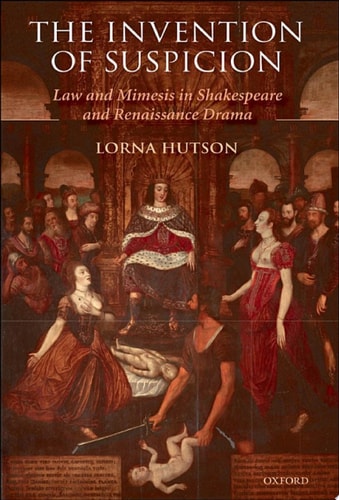
The Invention of Suspicion: Law and Mimesis in Shakespeare and Renaissance Drama
0
0
As an Amazon Associate and affiliate partner, Menrva Books earns from qualifying purchases. Learn more
Author Description
The Invention of Suspicion argues that the English justice system underwent changes in the sixteenth century that, because of the system's participatory nature, had a widespread effect and a decisive impact on the development of English Renaissance drama. These changes gradually made evidence evaluation a popular skill: justices of peace and juries were increasingly required to weigh up the probabilities of competing narratives of facts. At precisely the same time, English dramatists were absorbing, from Latin legal rhetoric and from Latin comedy, poetic strategies that enabled them to make their plays more persuasively realistic, more 'probable'. The result of this enormously rich conjunction of popular legal culture and ancient forensic rhetoric was a drama in which dramatis personae habitually gather evidence and 'invent' arguments of suspicion and conjecture about one another, thus prompting us, as readers and audience, to reconstruct this 'evidence' as stories of characters' private histories and inner lives. In this drama, people act in uncertainty, inferring one another's motives and testing evidence for their conclusions. As well as offering an overarching account of how changes in juridical epistemology relate to post-Reformation drama, this book examines comic dramatic writing associated with the Inns of Court in the overlooked decades of the 1560s and 70s. It argues that these experiments constituted an influential sub-genre, assimilating the structures of Roman comedy to current civic and political concerns with the administration of justice. This sub-genre's impact may be seen in Shakespeare's early experiments in revenge tragedy, history play and romance comedy, in Titus Andronicus, Henry VI and The Comedy of Errors, as well as Jonson's Every Man in his Humour, Bartholomew Fair and The Alchemist. The book ranges from mid-fifteenth century drama, through sixteenth century interludes to the drama of the 1590s and 1600s. It draws on recent research by leg
Menrva's Summary
THE THESIS
This book investigates how the evolution of the English justice system in the sixteenth century fundamentally shaped the narrative strategies and character development found in Renaissance drama. Lorna Hutson, a scholar of English literature, utilizes historical legal records and rhetorical theory to argue that the increasing requirement for juries to evaluate competing narratives of fact directly influenced how playwrights constructed realistic, evidence-based plots. By connecting forensic rhetoric with dramatic structure, the author demonstrates that the emergence of 'suspicion' as a legal tool provided the framework for characters to infer motives and construct private histories within plays.
THE SCOPE MAP
What You Will Find
- Analysis of sixteenth-century English legal procedures and the role of justices of peace.
- Examination of Latin legal rhetoric and its integration into Roman comedy.
- Case studies of early Shakespearean works including Titus Andronicus and The Comedy of Errors.
- Discussion of the Inns of Court drama during the 1560s and 1570s.
Scope Limits
- The text focuses primarily on the intersection of law and drama rather than a comprehensive history of Renaissance theater.
- It does not provide an exhaustive analysis of all Elizabethan playwrights, concentrating instead on those influenced by the specific legal-rhetorical sub-genre identified.
THE AUTHORITY PERSPECTIVE
Scholars recognize this work as a significant contribution to the study of how institutional shifts in law inform literary aesthetics. Readers frequently note the academic density of the prose, which requires a strong background in both early modern history and literary theory to fully appreciate the author's arguments.
Page Count:
393
Publication Date:
2011-01-01
Publisher:
OUP Oxford
ISBN-10:
0191615897
ISBN-13:
9780191615894
English drama
English
Legal History
In literature
Literary Criticism
English & College Success
History of Ideas
Community Tags
Similar Books