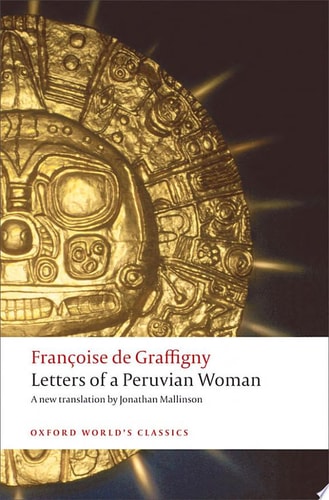
Letters of a Peruvian Woman
0
0
As an Amazon Associate and affiliate partner, Menrva Books earns from qualifying purchases. Learn more
Author Description
'It has taken me a long time, my dearest Aza, to fathom the cause of that contempt in which women are held in this country...' Zilia, an Inca Virgin of the Sun, is captured by the Spanish conquistadores and brutally separated from her lover, Aza. She is rescued and taken to France by Déterville, a nobleman, who is soon captivated by her. One of the most popular novels of the eighteenth century, the Letters of a Peruvian Woman recounts Zilia's feelings on her separation from both her lover and her culture, and her experience of a new and alien society. Françoise de Graffigny's bold and innovative novel clearly appealed to the contemporary taste for the exotic and the timeless appetite for love stories. But by fusing sentimental fiction and social commentary, she also created a new kind of heroine, defined by her intellect as much as her feelings. The novel's controversial ending calls into question traditional assumptions about the role of women both in fiction and society, and about what constitutes 'civilization'. ABOUT THE SERIES: For over 100 years Oxford World's Classics has made available the widest range of literature from around the globe. Each affordable volume reflects Oxford's commitment to scholarship, providing the most accurate text plus a wealth of other valuable features, including expert introductions by leading authorities, helpful notes to clarify the text, up-to-date bibliographies for further study, and much more.
Menrva's Summary
THE PULSE
After being abducted by Spanish conquistadors and separated from her lover, an Inca woman named Zilia must navigate the complexities of French society while maintaining her identity. Zilia attempts to reconcile her past as a Virgin of the Sun with her current status as a captive and guest in a foreign land. She faces the persistent romantic advances of her rescuer, Déterville, while grappling with the logical and social constraints of a culture she views as alien. The narrative is presented through an epistolary framework, allowing Zilia to document her observations and internal conflicts through letters addressed to her lost lover, Aza.
INSIDE THE PAGES
- Epistolary narrative structure consisting of letters written by the protagonist
- Exploration of the clash between Inca culture and 18th-century French society
- Intellectual development of the female protagonist beyond traditional sentimental tropes
- Critique of European social norms and gender roles
- Examination of the concept of civilization through an outsider's perspective
- Focus on themes of displacement, cultural identity, and autonomy
- Integration of philosophical inquiry within a romantic framework
- Unconventional ending that challenges contemporary literary expectations
THE COLLECTIVE ECHO
Discussion often centers on the novel's significance as a precursor to modern feminist literature and its unique use of the epistolary form to critique colonial perspectives. Readers frequently highlight the intellectual depth of Zilia, noting how she evolves from a passive victim into a self-aware individual who questions the values of her captors. Critics often point to the balance between the sentimental plot and the sharp social commentary that permeates the correspondence. The work is recognized for its ability to engage with the exoticism popular in the eighteenth century while simultaneously subverting those very tropes. Scholars emphasize that the text remains a vital study for understanding the intersection of gender, power, and cultural displacement in early modern fiction.
Page Count:
195
Publication Date:
2009-01-01
Publisher:
OUP Oxford
ISBN-10:
0191622613
ISBN-13:
9780191622618
Romance
France fiction
Epistolary
18th century
English
English & College Success
Historical
Social Commentary
classic
Community Tags
Similar Books