Belinda
0
0
As an Amazon Associate and affiliate partner, Menrva Books earns from qualifying purchases. Learn more
Author Description
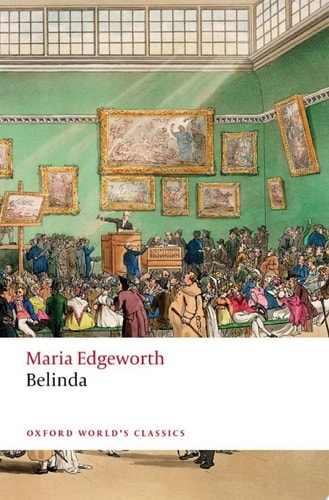
'It is singular, that my having spent a winter with one of the most dissipated women in England should have sobered my mind so completely.' Maria Edgeworth's 1801 novel, Belinda, is an absorbing, sometimes provocative, tale of social and domestic life among the English aristocracy and gentry. The heroine of the title, only too conscious of being 'advertised' on the marriage market, grows in moral maturity as she seeks to balance self-fulfilment with achieving material success. Among those whom she encounters are the socialite Lady Delacour, whose brilliance and wit hide a tragic secret, the radical feminist Harriot Freke, the handsome and wealthy Creole gentleman Mr Vincent, and the mercurial Clarence Hervey, whose misguided idealism has led him into a series of near-catastrophic mistakes. In telling their story Maria Edgeworth gives a vivid picture of life in late eighteenth-century London, skilfully showing both the attractions of leisured society and its darker side, and blending drawing-room comedy with challenging themes involving serious illness, obsession, slavery and interracial marriage.
Menrva's Summary
THE PULSE
Belinda Portman enters the high-stakes marriage market of London society, only to find her moral integrity tested by the volatile influences of the aristocracy. As she navigates the complex social expectations of the gentry, Belinda must reconcile her desire for personal autonomy with the rigid demands of her environment. She faces opposition from manipulative socialites and the erratic behavior of potential suitors, all while attempting to maintain her own sense of self. The narrative utilizes a third-person perspective to observe the interplay between individual character development and the restrictive social structures of the late eighteenth century.
INSIDE THE PAGES
- Exploration of the marriage market and its impact on female agency
- Satirical depiction of aristocratic dissipation and social vanity
- Examination of moral maturity through the protagonist's choices
- Integration of serious themes including illness and obsession
- Commentary on the consequences of misguided idealism
- Inclusion of diverse social archetypes from the radical to the wealthy
- Contrast between public performance and private tragedy
- Analysis of interracial marriage and slavery within the social context
THE COLLECTIVE ECHO
Readers and critics frequently highlight the novel's sharp social commentary and its nuanced portrayal of the marriage market. Discussion often centers on the contrast between the protagonist's steady moral growth and the chaotic, often destructive, lives of the secondary characters. Many observers note that the prose effectively balances drawing-room comedy with more somber, challenging thematic elements. The work is often cited for its vivid depiction of late eighteenth-century London, providing a clear window into the tensions between personal fulfillment and societal expectations. Readers appreciate the author's ability to maintain a critical distance from the aristocracy while still engaging with the complexities of their domestic lives.
Page Count:
560
Publication Date:
2020-01-01
Publisher:
OUP Oxford
ISBN-10:
0191504696
ISBN-13:
9780191504693
Romance
Historical
Domestic
classic
English & College Success
English
18th century
Social Satire
Community Tags
Other Editions(15)

Digireads.com
2021
Default edition
HardPress
2020
OUP Oxford
2020

Creative Media Partners, LLC
2018

Creative Media Partners, LLC
2018

CreateSpace Independent Publishing Platform
2018

Creative Media Partners, LLC
2018

Nabu Press
2011

Kessinger Publishing, LLC
2010
Nabu Press
2010

General Books LLC
2010
Nabu Press
2010

Pickering & Chatto
2003

Oup Oxford
1999

Oxford University Press
1994
Similar Books



Reader Comments
Share Your Thoughts
No comments yet. Be the first to share your thoughts!