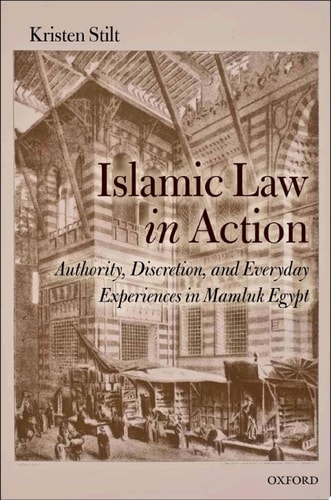
Islamic Law in Action: Authority, Discretion, and Everyday Experiences in Mamluk Egypt
0
0
As an Amazon Associate and affiliate partner, Menrva Books earns from qualifying purchases. Learn more
Author Description
A dynamic account of the practice of Islamic law, this book focuses on the actions of a particular legal official, the muhtasib, whose vast jurisdiction included all public behavior. In the cities of Cairo and neighboring Fustat during the Mamluk period (1250-1517), the men who held the position of muhtasib acted as regulators of markets and public spaces generally. They traversed their jurisdictions carrying out the duty to command right and forbid wrong, and were as much a part of the legal landscape as the better-known figures of judge and mufti. Taking directions from the rulers, the sultan foremost among them, they were also guided by legal doctrine as formulated by the jurists, combining these two sources of law in one face of authority. The daily workings of the law are illuminated by the reports of the muhtasib in the vivid Mamluk-era chronicles, which often also captured the responses of the individuals who encountered the official. The book is organized around actions taken by the muhtasib in the areas of Muslim devotional and pious practices; crimes and offenses; the management of Christians and Jews; market regulation and consumer protection; the specific markets for essential bread; currency and taxes; and public order. The case studies presented show that while legal doctrine was clearly relevant to the muhtasib's actions, the policy demands of the sultan were also quite significant, and rules from both sources of authority intersected with social, political, economic, and personal factors to create full and vibrant scenarios that reveal the practice of Islamic law.
Menrva's Summary
THE THESIS
This book investigates how Islamic law functioned in practice within Mamluk Egypt by examining the role and jurisdiction of the muhtasib. Kristen Stilt, a scholar of Islamic law and history, utilizes Mamluk-era chronicles and legal doctrine to analyze the intersection of state policy and religious jurisprudence. The work argues that the muhtasib served as a critical nexus where sultanic authority and traditional legal interpretation met to govern public behavior and market activity. By focusing on the daily application of law, the author demonstrates how these officials navigated the complex social and political landscape of Cairo and Fustat.
THE SCOPE MAP
What You Will Find
- Analysis of the muhtasib's jurisdiction over public order, markets, and religious practice
- Examination of the interplay between sultanic decrees and established juristic doctrine
- Case studies covering bread production, currency regulation, and the treatment of religious minorities
Scope Limits
- The study is geographically confined to Cairo and Fustat during the Mamluk period (1250-1517)
- The analysis focuses primarily on the muhtasib rather than the broader judiciary or the mufti system
THE AUTHORITY PERSPECTIVE
Scholars and historians frequently cite this work as a foundational text for understanding the practical application of law in pre-modern Islamic societies. Readers often note the academic density of the prose, which provides a rigorous examination of primary source chronicles to reconstruct the daily legal experience.
Page Count:
254
Publication Date:
2012-01-01
Publisher:
OUP Oxford
ISBN-10:
0191629820
ISBN-13:
9780191629822
History
Middle Eastern
Legal History
Islamic Studies
Muḥtasib
Professional Career & Trade
Sociology of Law
Mamluk Egypt
Islamic Law
Egypt - History