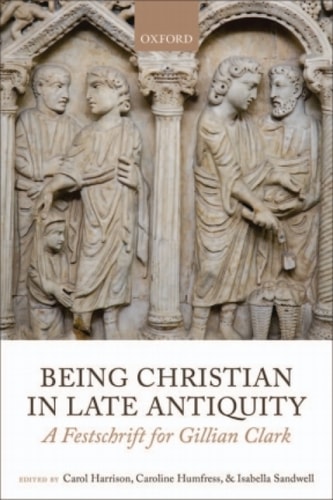
Being Christian in Late Antiquity: A Festschrift for Gillian Clark
0
0
As an Amazon Associate and affiliate partner, Menrva Books earns from qualifying purchases. Learn more
Author Description
What do we mean when we talk about 'being Christian' in Late Antiquity? This volume brings together sixteen world-leading scholars of ancient Judaism, Christianity and, Greco-Roman culture and society to explore this question, in honour of the ground-breaking scholarship of Professor Gillian Clark. After an introduction to the volume's dedicatee and themes by Averil Cameron, the papers in Section I, `Being Christian through Reading, Writing and Hearing', analyse the roles that literary genre, writing, reading, hearing and the literature of the past played in the formation of what it meant to be Christian. The essays in Section II move on to explore how late antique Christians sought to create, maintain and represent Christian communities: communities that were both 'textually created' and 'enacted in living realities'. Finally in Section III, 'The Particularities of Being Christian', the contributions examine what it was to be Christian from a number of different ways of representing oneself, each of which raises questions about certain kinds of 'particularities', for example, gender, location, education and culture. Bringing together primary source material from the early Imperial period up to the seventh century AD and covering both the Eastern and Western Empires, the papers in this volume demonstrate that what it meant to be Christian cannot simply be taken for granted. 'Being Christian' was part of a continual process of construction and negotiation, as individuals and Christian communities alike sought to relate themselves to existing traditions, social structures and identities, at the same time as questioning and critiquing the past(s) in their present.
Menrva's Summary
THE THESIS
This volume investigates the multifaceted and evolving nature of Christian identity during the period of Late Antiquity. The editors, Carol E. Harrison, Caroline Humfress, and Isabella Sandwell, curate a collection of essays from sixteen scholars to honor the work of Professor Gillian Clark. The text argues that 'being Christian' was not a static state but a continuous process of construction and negotiation within existing social and cultural structures.
THE SCOPE MAP
What You Will Find
- Analysis of literary genres and the role of reading, writing, and hearing in identity formation
- Examination of how Christian communities were created and maintained
- Studies on the intersection of Christian identity with gender, location, and education
- Primary source material spanning the early Imperial period to the seventh century AD
Scope Limits
- The volume focuses specifically on the context of Late Antiquity and does not provide a comprehensive history of Christianity beyond the seventh century
THE AUTHORITY PERSPECTIVE
Scholars and historians recognize this collection as a significant contribution to the study of religious identity in the ancient world. The text is noted for its academic rigor and its ability to synthesize complex social and cultural data from both the Eastern and Western Empires.
Page Count:
320
Publication Date:
2014-01-01
Publisher:
OUP Oxford
ISBN-10:
0191629537
ISBN-13:
9780191629532
History
Religion
Late Antiquity
Festschrift
Academic
Christianity
Judaism
Community Tags
Similar Books