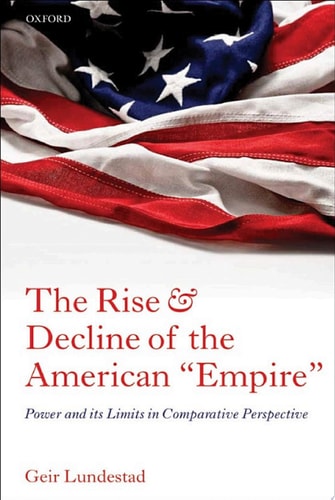
The Rise and Decline of the American "Empire": Power and its Limits in Comparative Perspective
0
0
As an Amazon Associate and affiliate partner, Menrva Books earns from qualifying purchases. Learn more
Author Description
The Rise and Decline of the American "Empire" explores the rapidly growing literature on the rise and fall of the United States. The author argues that after 1945 the US has definitely been the most dominant power the world has seen and that it has successfully met the challenges from, first, the Soviet Union and, then, Japan, and the European Union. Now, however, the United States is in decline: its vast military power is being challenged by asymmetrical wars, its economic growth is slow and its debt is rising rapidly, the political system is proving unable to meet these challenges in a satisfactory way. While the US is still likely to remain the world's leading power for the foreseeable future, it is being challenged by China, particularly economically, and also by several other regional Great Powers. The book also addresses the more theoretical question of what recent superpowers have been able to achieve and what they have not achieved. How could the United States be both the dominant power and at the same time suffer significant defeats? And how could the Soviet Union suddenly collapse? No power has ever been omnipotent. It cannot control events all around the world. The Soviet Union suffered from imperial overstretch; the traditional colonial empires suffered from a growing lack of legitimacy at the international, national, and local levels. The United States has been able to maintain its alliance system, but only in a much reformed way. If a small power simply insists on pursuing its own very different policies, there is normally little the United States and other Great Powers will do. Military intervention is an option that can be used only rarely and most often with strikingly limited results.
Menrva's Summary
THE THESIS
This work investigates the trajectory of American global dominance, questioning whether the United States is currently experiencing a structural decline similar to historical empires. Geir Lundestad, a prominent historian of international relations, utilizes a comparative framework to analyze the post-1945 era. He examines the intersection of military overreach, economic stagnation, and political gridlock to argue that while the U.S. remains a leading power, its capacity to dictate global outcomes is increasingly constrained by emerging regional rivals and internal systemic failures.
THE SCOPE MAP
What You Will Find
- Comparative analysis of the United States, the Soviet Union, and traditional colonial empires.
- Evaluation of post-WWII geopolitical challenges including the Cold War, the rise of Japan, and the European Union.
- Assessment of contemporary threats such as asymmetrical warfare, rising national debt, and the economic ascent of China.
Scope Limits
- The text does not provide a predictive model for the exact timeline of American decline.
- It focuses primarily on state-level power dynamics rather than domestic social or cultural shifts.
THE AUTHORITY PERSPECTIVE
Scholars and political analysts frequently cite this text for its balanced, non-alarmist approach to the debate over American hegemony. Readers often note the academic rigor of the prose, which makes it a standard reference for those studying the limitations of superpower influence in the modern era.
Page Count:
221
Publication Date:
2012-01-01
Publisher:
OUP Oxford
ISBN-10:
0191641006
ISBN-13:
9780191641008
History
International relations
United States
American Studies
Geopolitics
Community Tags
Similar Books