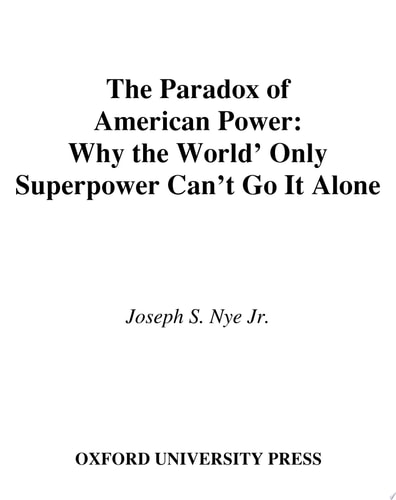
The Paradox of American Power
0
0
As an Amazon Associate and affiliate partner, Menrva Books earns from qualifying purchases. Learn more
Author Description
Not Since The Roman Empire Has Any Nation Had As Much Economic, Cultural, And Military Power As The United States Does Today. Yet, As Has Become All Too Evident Through The Terrorist Attacks Of September 11th And The Impending Threat Of The Acquisition Of Nuclear Weapons By Iran, That Power Is Not Enough To Solve Global Problems--like Terrorism, Environmental Degradation, And The Proliferation Of Weapons Of Mass Destruction--without Involving Other Nations. Here Joseph S. Nye, Jr. Focuses On The Rise Of These And Other New Challenges And Explains Clearly Why America Must Adopt A More Cooperative Engagement With The Rest Of The World.
Menrva's Summary
THE THESIS
The central question investigated is how the United States can effectively utilize its unprecedented economic, cultural, and military dominance to address complex global challenges that require international cooperation. Joseph S. Nye Jr., a distinguished scholar and former government official, utilizes his extensive background in international relations theory to analyze the limitations of unilateral power. He argues that the modern landscape of global threats—ranging from terrorism to environmental degradation—necessitates a shift toward a more cooperative engagement strategy. By examining the nature of power in the 21st century, Nye provides a framework for understanding why traditional military might is insufficient for solving contemporary transnational issues.
THE SCOPE MAP
What You Will Find
- Analysis of the transition from traditional hard power to the necessity of soft power in global diplomacy.
- Examination of post-9/11 security challenges and the proliferation of weapons of mass destruction.
- Case studies on the limitations of unilateralism in addressing environmental and economic instability.
- A strategic framework for integrating multilateral alliances into American foreign policy.
THE AUTHORITY PERSPECTIVE
Experts and political scientists frequently cite this work as a foundational text for understanding the evolution of American foreign policy in the post-Cold War era. Readers often note the clarity of the prose, which makes complex geopolitical theories accessible to both students and policy practitioners.
Page Count:
240
Publication Date:
2002-01-01
Publisher:
Oxford University Press
ISBN-10:
0198034369
ISBN-13:
9780198034360
History
Geopolitics
International relations
American Studies
Community Tags
Other Editions(2)
Similar Books