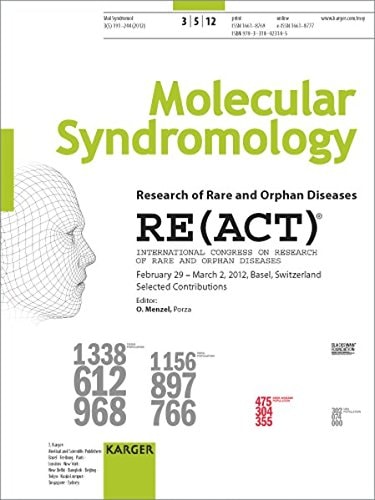
Research in Rare and Orphan Diseases Re(ACT): International Congress on Research of Rare and Orphan Diseases, Basel, February/March 2012
0
0
As an Amazon Associate and affiliate partner, Menrva Books earns from qualifying purchases. Learn more
Author Description
The medical community does not see rare diseases as a field of priority. In fact, poor characterization of the natural causes, pathologies and low numbers of cases make diagnosis difficult, often resulting in a real ordeal for patients and their families. This special issue of Molecular Syndromology presents six selected contributions of the First International Congress on Research of Rare and Orphan Diseases which brought together courageous researchers working on rare and orphan diseases. It shows the growing research interest in rare and orphan diseases, the new experimental approaches, such as next generation sequencing and therapeutic possibilities. Topics outlined in this issue are: Current debates on the emerging technical, medical and ethical issues Potential optimum use of the available technology Molecular genetics of Charcot-Marie-Tooth diseases Amelogenesis imperfecta - a clinically and genetically heterogeneous group of inherited defects of enamel formation Smith-Lemli-Opitz syndrome - an autosomal recessive disorder characterized by multiple congenital abnormalities and mental retardation Strategies for therapeutic suppression of nonsense mutations in inherited metabolic diseases Furthermore, the involvement of patient organizations in the development of orphan drugs for rare diseases is emphasized. This volume is essential reading for all researchers in the fields of human genetics and syndromology and everyone interested in the study of rare diseases.
Menrva's Summary
THE THESIS
The medical community's prioritization of rare diseases is questioned, highlighting the diagnostic challenges and patient ordeals stemming from poor characterization and low case numbers. This special issue of Molecular Syndromology presents six selected contributions from the First International Congress on Research of Rare and Orphan Diseases, showcasing the growing research interest and novel experimental approaches in this field. It explores emerging technical, medical, and ethical issues, the optimal use of technology, and specific genetic disorders like Charcot-Marie-Tooth diseases, Amelogenesis imperfecta, and Smith-Lemli-Opitz syndrome. The volume also addresses therapeutic strategies for inherited metabolic diseases and emphasizes the crucial role of patient organizations in orphan drug development.
THE SCOPE MAP
- Current debates on emerging technical, medical, and ethical issues in rare disease research.
- Potential optimum use of available technology in the study of rare and orphan diseases.
- Molecular genetics of Charcot-Marie-Tooth diseases.
- Amelogenesis imperfecta: a clinically and genetically heterogeneous group of inherited defects of enamel formation.
- Smith-Lemli-Opitz syndrome: an autosomal recessive disorder characterized by multiple congenital abnormalities and mental retardation.
- Strategies for therapeutic suppression of nonsense mutations in inherited metabolic diseases.
- The involvement of patient organizations in the development of orphan drugs for rare diseases.
THE AUTHORITY PERSPECTIVE
This volume is presented as essential reading for researchers in human genetics and syndromology, as well as anyone interested in the study of rare diseases. The collection aims to demonstrate the growing research interest and new experimental approaches in the field, including next-generation sequencing and therapeutic possibilities. The emphasis on ethical issues and patient organization involvement suggests a comprehensive overview of the current landscape of rare disease research and treatment development.
Page Count:
54
Publication Date:
2012-12-01
Publisher:
S. Karger AG
ISBN-10:
3318023140
ISBN-13:
9783318023145
Science
Non-Fiction
Metabolic Diseases
Genetics
Rare Diseases
Community Tags
Similar Books