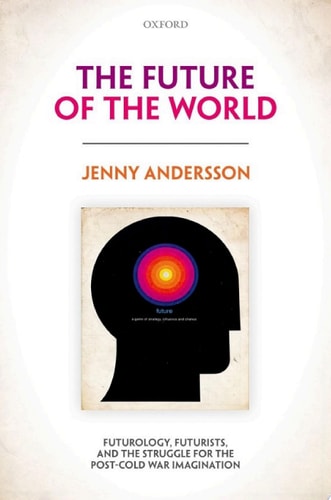
The Future of the World: Futurology, Futurists, and the Struggle for the Post Cold War Imagination
0
0
As an Amazon Associate and affiliate partner, Menrva Books earns from qualifying purchases. Learn more
Author Description
The Future of the World is devoted to the intriguing field of study which emerged after World War Two, futurism or futurology. Jenny Andersson explains how futurist scholars and researchers imagined the Cold War and post Cold War world and the tools and methods they would use to influence and change that world. Futurists were a motley crew of Cold War warriors, nuclear scientists, journalists, and peace activists. Some argued it should be a closed sphere of science defined by delimited probabilities. They were challenged by alternative notions of the future as a potentially open realm. Futurism also drew on an eclectic range of repertoires, some of which were deduced from positivist social science, mathematics, and nuclear physics, and some of which sprung from alternative forms of knowledge in science fiction, journalism, or religion. These different forms of prediction laid very different claims to how accurately futures could be known, and what kind of control could be exerted over what was yet to come. The Future of the World carefully examines these different engagements with the future, and inscribes them in the intellectual history of the post war period. Using unexplored archival collections, The Future of the World reconstructs the Cold War networks of futurologists and futurists.
Menrva's Summary
THE THESIS
This book investigates how the field of futurology emerged after World War Two and how its practitioners sought to define, predict, and influence the trajectory of the Cold War and the subsequent post-Cold War era. Jenny Andersson, a historian of ideas, utilizes previously unexplored archival collections to map the intellectual networks of futurists. She argues that these individuals—ranging from nuclear scientists to peace activists—employed diverse methodologies to claim authority over the future, effectively turning the unknown into a site of political and scientific contestation.
THE SCOPE MAP
What You Will Find
- Analysis of post-war intellectual networks and the professionalization of futurism.
- Examination of methodologies derived from positivist social science, mathematics, and nuclear physics.
- Exploration of the tension between deterministic scientific prediction and alternative, open-ended visions of the future.
Scope Limits
- The text does not provide a comprehensive history of all speculative fiction or science fiction literature.
- It does not offer a predictive model for current global events, focusing instead on the historical development of the field.
THE AUTHORITY PERSPECTIVE
Scholars in the field of intellectual history recognize this work as a rigorous examination of the intersection between scientific expertise and political imagination. Readers frequently note the academic density of the prose, which provides a detailed reconstruction of mid-century institutional thought.
Page Count:
0
Publication Date:
1900-01-01
Publisher:
Oxford University Press
ISBN-10:
0191851914
ISBN-13:
9780191851919
History
Cold War
Sociology
Intellectual History
Futurology