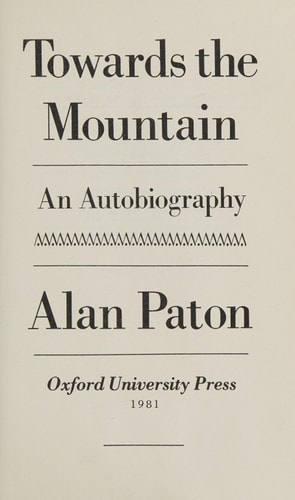
Towards the Mountain: Autobiography
0
0
As an Amazon Associate and affiliate partner, Menrva Books earns from qualifying purchases. Learn more
Author Description
Towards the Mountain is the moving autobiography of the author of Cry, the Beloved Country and an illuminating look at the politics and history of South Africa in this century. Born in Pietermaritzburg, South Africa, in 1903, Alan Paton was the son of deeply religious parents and grew up highly sensitive to questions of philosophy and to the beauty of the natural world. In Towards the Mountain he recalls his early life, his education, and his feelings about his country. He describes in detail his years as principal of Diepkloof, the reformatory for young blacks, where he was able to introduce revolutionary reforms despite a long tradition of rigidity and harshness. Those reforms brought him into conflict with the hard-line advocates of apartheid-who later gained political supremacy-making him all the more aware of the tensions and complexities of South African life. In 1948, on a world tour to study the penal systems of other countries, Paton reached a turning point in his life. The result was Cry, the Beloved Country, the now-classic novel of injustice, forgiveness, and hope, a book that thirty years later still speaks eloquently to men's hearts and minds. A leader in the fight for human justice, Alan Paton has written a number of important books and has stood fast against the ever increasing pressures of the South African government. Towards the Mountain is his story up to the publication of Cry, the Beloved Country, a portrait of a man of tremendous moral courage. It is a story important to us all.
Menrva's Summary
THE THESIS
This autobiography examines the personal and political evolution of Alan Paton, questioning how an individual’s moral framework is shaped by and subsequently challenges the systemic injustices of mid-twentieth-century South Africa. Paton, a prominent writer and activist, utilizes his own life as a lens to analyze the intersection of religious upbringing, educational philosophy, and the burgeoning political tensions that culminated in the apartheid era. The text serves as a historical record of his tenure at the Diepkloof Reformatory and the subsequent creation of his seminal literary work, providing a detailed account of his transition from an educator to a public figure of resistance.
THE SCOPE MAP
What You Will Find
- Detailed accounts of the South African educational and penal systems in the early 20th century.
- Personal reflections on the influence of religious and philosophical upbringing.
- Historical context regarding the political climate leading up to the 1948 implementation of apartheid.
- Insights into the creative process behind the novel Cry, the Beloved Country.
Scope Limits
- The narrative concludes with the publication of Cry, the Beloved Country and does not cover the later decades of the author's life.
- The text focuses primarily on the author's internal moral development rather than a comprehensive political history of the entire nation.
THE AUTHORITY PERSPECTIVE
Scholars and critics frequently cite this work as a foundational text for understanding the intellectual climate of South Africa prior to the full entrenchment of apartheid. Readers often note the prose is reflective and measured, providing a clear window into the moral dilemmas faced by a prominent anti-apartheid figure.
Page Count:
320
Publication Date:
1981-01-01
Publisher:
David Philip
ISBN-10:
0192117807
ISBN-13:
9780192117809
Memoir
Autobiography
History
Politics
Biography
African history
Community Tags
Similar Books