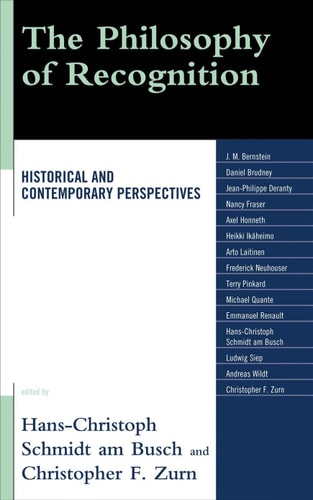
The Philosophy of Recognition: Historical and Contemporary Perspectives
0
0
As an Amazon Associate and affiliate partner, Menrva Books earns from qualifying purchases. Learn more
Author Description
The theory of recognition is now a well-established and mature research paradigm in philosophy, and it is both influential in and influenced by developments in other fields of the humanities and social sciences. From debates in moral philosophy about the fundamental roots of obligation, to debates in political philosophy about the character of multicultural societies, to debates in legal theory about the structure and justification of rights, to debates in social theory about the prospects and proper objects of critical theory, to debates in ontology, philosophical anthropology and psychology about the structure of personal and group identities, theories based on the concept of intersubjective recognition have staked out central positions. At the same time, contemporary theories of recognition are strongly, perhaps indissociably, connected to themes in the history of philosophy, especially as treated in German idealism. This volume compromises a collection of original papers by eminent international scholars working at the forefront of recognition theory and provides an unparalleled view of the depth and diversity of philosophical research on the topic. Its particular strength is in exploring connections between the history of philosophy and contemporary research by combining in one volume full treatments of classical authors on recognition-Rousseau, Kant, Fichte, Hegel, Marx, Freud-with cutting edge work by leading contemporary philosophers of recognition, including Fraser, Honneth, and others.
Menrva's Summary
THE THESIS
This volume investigates the multifaceted theory of recognition and its profound impact across various philosophical and social disciplines. The book explores how recognition theory, deeply rooted in German idealism, has become a central paradigm influencing debates on obligation, multiculturalism, rights, critical theory, and identity. It examines the connections between historical figures like Rousseau, Kant, Fichte, Hegel, Marx, and Freud, and contemporary thinkers such as Fraser and Honneth, offering a comprehensive overview of current research.
THE SCOPE MAP
- Exploration of recognition theory's historical roots in German idealism, including detailed treatments of Rousseau, Kant, Fichte, Hegel, Marx, and Freud.
- Analysis of contemporary recognition theory through the work of leading philosophers like Fraser and Honneth.
- Discussions on the implications of recognition theory for moral philosophy, focusing on the foundations of obligation.
- Examination of recognition's role in political philosophy, particularly concerning multicultural societies.
- Investigation into legal theory, addressing the structure and justification of rights.
- Consideration of social theory and the prospects for critical theory.
- Exploration of ontological, philosophical anthropological, and psychological dimensions of personal and group identities.
THE AUTHORITY PERSPECTIVE
This collection of original papers by eminent international scholars provides an unparalleled view of the depth and diversity of philosophical research on recognition theory. The volume's strength lies in its synthesis of historical perspectives, featuring in-depth analyses of classical authors, with cutting-edge work by contemporary philosophers. It is positioned as a key resource for understanding the interdisciplinary influence and foundational importance of recognition theory across moral, political, legal, and social sciences.
Page Count:
385
Publication Date:
2009-01-01
Publisher:
Lexington Books
ISBN-10:
0739144278
ISBN-13:
9780739144275
Philosophy
Psychology
Non-Fiction
Moral Philosophy
Social Theory
Ontology
Political Philosophy
Legal Theory
Identity
Community Tags
Similar Books