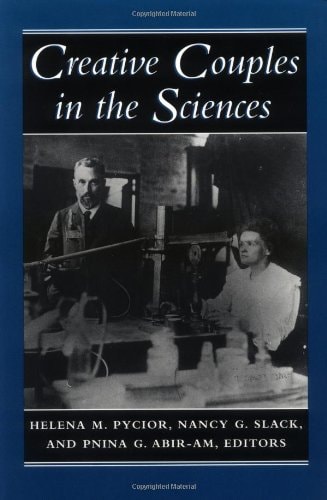
Creative Couples in the Sciences
0
0
As an Amazon Associate and affiliate partner, Menrva Books earns from qualifying purchases. Learn more
Author Description
Can two scientists work and live together? Marie and Pierre Curie proved that it was indeed possible to have a happy marriage and do brilliant research together. This collection of seventeen original essays explores the interplay between marriage and scientific work in the lives of two dozen couples in the nineteenth and twentieth century. It is the first book to discuss the professional and personal lives of scientific couples. For much of this period, marriage was the only acceptable way a woman could gain access to the tools, space, and colleagues indispensable to doing science. Yet, collaboration with her husband could also mean the denial of full credit for her work, inability to move to better jobs, and the juggling of domestic and scientific responsibilities. For the husband, collaboration with his skilled, unpaid wife could bring greater achievements than he might have achieved alone, but also meant the suspicion of his professional peers and the necessity of supporting the household. The creative couples described in this volume range from Nobel Prize winners and world-renowned social scientists to obscure field biologists. The essays describe marriages and scientific collaborations that were a joy to both partners, as well as those that proved disastrous. In addition to the editors, the contributors are Marianne Gosztonyi Ainley, Barbara J. Becker, Bernadette Bensaude-Vincent, Mildred Cohn, Janet Bell Garber, Christiane Groeben, Joy Harvey, Susan Hoecker-Drysdale, Pamela M. Henson, Maureen J. Julian, Sylvia W. McGrath, Marilyn Bailey Ogilvie, John Stachel, Linda Tucker, and Sylvia Wiegand. They provide unique insights into the nature of cross-gender collaboration and intimacy. This volume will be of enormous interest to contemporary scientists, to historians of science, and to anyone interested in the ways women and men share marriage and work.
Menrva's Summary
THE THESIS
This book investigates the complex relationship between marriage and scientific collaboration in the lives of couples during the nineteenth and twentieth centuries. The collection explores how partnerships influenced scientific work and personal lives, examining the unique challenges and benefits of cross-gender collaboration. It highlights how marriage, for much of this period, was a primary avenue for women to access scientific resources, though it often came at the cost of full recognition and career advancement. Conversely, husbands benefited from skilled, unpaid partners but faced professional suspicion and the burden of sole household support.
THE SCOPE MAP
- Exploration of seventeen original essays detailing the interplay between marriage and scientific work.
- Focus on two dozen couples across the nineteenth and twentieth centuries.
- Discussion of the professional and personal lives of scientific couples, a first in book form.
- Analysis of how marriage provided women access to scientific tools, space, and colleagues.
- Examination of the drawbacks for women, including denial of credit and difficulty balancing domestic and scientific duties.
- Consideration of the benefits and drawbacks for husbands, such as enhanced achievements versus professional suspicion.
- Inclusion of diverse couples, from Nobel laureates to obscure field biologists.
- Insights into both joyful and disastrous marriages and scientific collaborations.
THE AUTHORITY PERSPECTIVE
This volume is of significant interest to contemporary scientists, historians of science, and anyone studying the dynamics of shared marriage and work. The collection offers unique insights into cross-gender collaboration and intimacy within scientific partnerships. The essays provide a nuanced view of how personal relationships shaped scientific discovery and careers. The book is valuable for understanding the historical context of women in science and the nature of collaborative endeavors.
Page Count:
369
Publication Date:
1996-01-01
Publisher:
Rutgers University Press
ISBN-10:
0813521882
ISBN-13:
9780813521886
Biography
History
Non-Fiction
Gender Studies
Social History
Community Tags
Similar Books