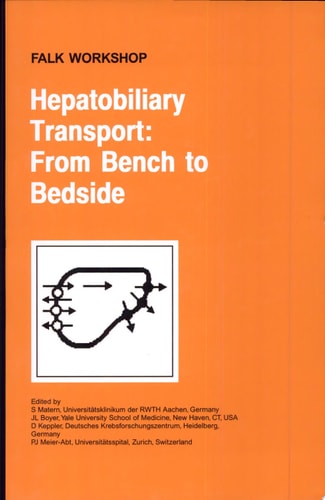
Hepatobiliary Transport: From Bench to Bedside
0
0
As an Amazon Associate and affiliate partner, Menrva Books earns from qualifying purchases. Learn more
Author Description
There has been a tremendous amount of scientific progress in our understanding of the molecular mechanisms of transport processes in the liver within the last few years. Cloning of various members of organic anion and cation transporters has provided the necessary tools to study their regulation under physiological and pathophysiological conditions and has advanced our knowledge about bile formation. Mutations of various hepatic organic anion transporters have been identified in humans as hereditary defects leading to the heterogenous syndrome of progressive familial intrahepatic cholestasis (PFIC). Various mouse models including knockout animals have given us the opportunity to gain insight into lipid transport by the liver and the genetics of cholesterol gallstone formation. The physiology of bile duct cells and the molecular mechanisms leading to various cholangiopathies have been a main scientific focus in hepatology in recent years. Drug targeting to the liver by hepatic organic anion transporters represents an attractive way of selective delivery of pharmaceutical agents in humans. Ursodeoxycholic acid is successfully used in the treatment of patients with chronic cholestatic liver disease and major advances have been made in understanding its mode of action in liver and bile duct cells. This book, the proceedings of the Falk Workshop held in Aachen, Germany, on 25-26 January 2001, contains chapters on all important aspects of biliary transport by well-known experts in this field. It is an essential resource for new developments in the field of biliary transport, both in basic science and clinical medicine.
Menrva's Summary
THE THESIS
This book investigates the molecular mechanisms of transport processes in the liver and their implications for human health and disease. It details recent scientific progress, including the cloning of organic anion and cation transporters, which has enabled a deeper understanding of bile formation and hereditary defects like progressive familial intrahepatic cholestasis. The work also explores insights gained from mouse models regarding lipid transport and cholesterol gallstone formation, as well as the physiology of bile duct cells and the molecular basis of cholangiopathies.
THE SCOPE MAP
- Molecular mechanisms of organic anion and cation transporters in the liver.
- Insights into bile formation and regulation under physiological and pathophysiological conditions.
- Genetic defects leading to progressive familial intrahepatic cholestasis (PFIC).
- Mouse models for studying lipid transport and cholesterol gallstone formation.
- Physiology of bile duct cells and molecular mechanisms of cholangiopathies.
- Drug targeting strategies utilizing hepatic organic anion transporters.
- Mode of action of ursodeoxycholic acid in cholestatic liver disease.
THE AUTHORITY PERSPECTIVE
This book, a compilation of proceedings from the Falk Workshop held in Aachen, Germany, in January 2001, presents key developments in biliary transport from both basic science and clinical medicine perspectives. It features contributions from leading experts in the field, covering essential aspects of hepatic and biliary transport mechanisms. The content is designed to inform researchers and clinicians about the latest advancements and their practical applications. It serves as a valuable resource for understanding the complex processes of liver and bile duct cell function and disease.
Page Count:
167
Publication Date:
2001-12-31
Publisher:
Springer Science & Business Media
ISBN-10:
0792387716
ISBN-13:
9780792387718
Science
Non-Fiction
Drug Targeting
Hepatology
Genetics
Community Tags
Similar Books