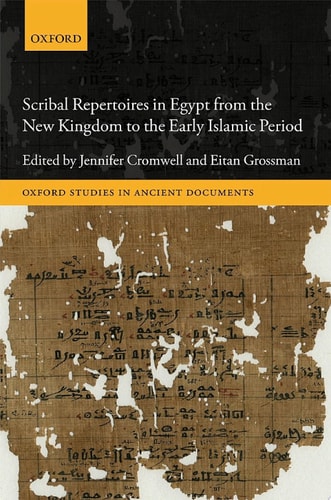
Scribal Repertoires in Egypt from the New Kingdom to the Early Islamic Period
0
0
As an Amazon Associate and affiliate partner, Menrva Books earns from qualifying purchases. Learn more
Author Description
Scribal Repertoires in Egypt from the New Kingdom to the Early Islamic Period deals with the possibility of glimpsing pre-modern and early modern Egyptian scribes, the actual people who produced ancient documents, through the ways in which they organized and wrote those documents. While traditional research has focused on identifying a 'pure' or 'original' text behind the actual manuscripts that have come down to us from pre-modern Egypt, the volume looks instead at variation - different ways of saying the same thing - as a rich source for understanding the complex social and cultural environments in which scribes lived and worked, breaking with the traditional conception of variation in scribal texts as 'free' or indicative of 'corruption'. As such, it presents a novel reconceptualization of scribal variation in pre-modern Egypt from the point of view of contemporary historical sociolinguistics, seeing scribes as agents embedded in particular geographical, temporal, and socio-cultural environments. Introducing to Egyptology concepts such as scribal communities, networks, and repertoires, among others, the authors then apply them to a variety of phenomena, including features of lexicon, grammar, orthography, palaeography, layout, and format. After first presenting this conceptual framework, they demonstrate how it has been applied to better-studied pre-modern societies by drawing upon the well-established domain of scribal variation in pre-modern English, before proceeding to a series of case studies applying these concepts to scribal variation spanning thousands of years, from the languages and writing systems of Pharaonic times, to those of Late Antique and Islamic Egypt.
Menrva's Summary
THE THESIS
This volume investigates whether the social and cultural identities of pre-modern Egyptian scribes can be reconstructed by analyzing the variations in their document production. The authors, Eitan Grossman and Jennifer Cromwell, utilize a historical sociolinguistic framework to move beyond the traditional search for 'original' texts. By treating scribal variation as intentional and meaningful rather than as evidence of corruption, they argue that scribes were active agents shaped by their specific temporal and geographical environments.
THE SCOPE MAP
What You Will Find
- A theoretical framework incorporating concepts of scribal communities, networks, and repertoires.
- Comparative analysis drawing on established research regarding scribal variation in pre-modern English.
- Case studies covering linguistic and orthographic features from the New Kingdom through the early Islamic period.
Scope Limits
- The study does not attempt to reconstruct a singular 'pure' text for the documents analyzed.
- The analysis is restricted to the specific socio-cultural contexts of Egypt and does not provide a comprehensive history of all ancient writing systems.
THE AUTHORITY PERSPECTIVE
Experts recognize this work as a significant methodological shift in Egyptology, successfully applying modern sociolinguistic tools to ancient manuscript studies. Readers frequently note the academic density of the prose, which serves as a rigorous resource for scholars interested in the intersection of linguistics and history.
Page Count:
393
Publication Date:
2017-01-01
Publisher:
OUP Oxford
ISBN-10:
0192508466
ISBN-13:
9780192508461
History
English
Egyptology
Linguistics
Ancient History
Paleography
English & College Success
Egypt
Coptic Inscriptions
Community Tags
Other Editions(2)
Similar Books
Reader Comments
Share Your Thoughts
No comments yet. Be the first to share your thoughts!