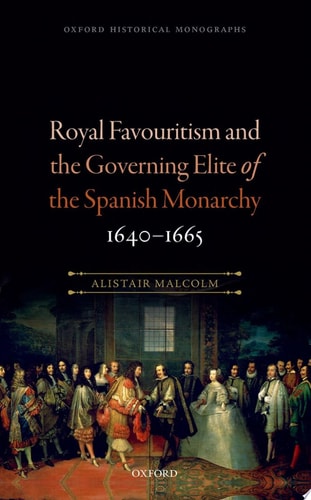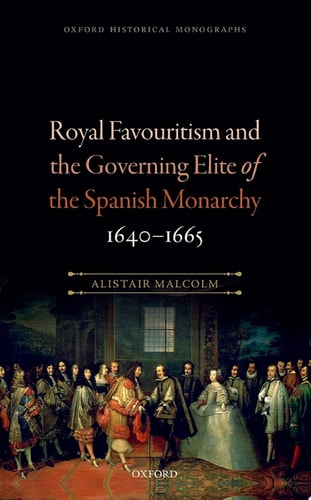
Royal Favouritism and the Governing Elite of the Spanish Monarchy, 1640-1665
0
0
As an Amazon Associate and affiliate partner, Menrva Books earns from qualifying purchases. Learn more
Author Description
Royal Favouritism and the Governing Elite of the Spanish Monarchy, 1640-1665 presents a study of the later years of the reign of Philip IV from the perspective of his favourite (valido), don Luis Méndez de Haro, and of the other ministers who helped govern the Spanish Habsburg Monarchy. It offers a positive vision of a period that is often seen as one of failure and decline. Unlike his predecessors, Haro exercised the favour that he enjoyed in a discreet way, acting as a perfect courtier and honest broker between the king and his aristocratic subjects. Nevertheless, Alistair Malcolm also argues that the presence of a royal favourite at the head of the government of Spain amounted to a major problem. The king's delegation of his authority to a single nobleman was considered by many to have been incompatible with good kingship, and Philip IV was himself very uneasy about failing in his responsibilities as a ruler. Haro was thus in a highly insecure situation, and sought to justify his regime by organizing the management of a prestigious and expensive foreign policy. In this context, the eventual conclusion of the very honourable peace with France in 1659 is shown to have been as much the result of the independent actions of other ministers as it was of a royal favourite very reluctantly brought to the negotiating table at the Pyrenees. By conclusion, the quite sudden collapse of Spanish European hegemony after Haro's death in 1661 is represented as a delayed reaction to the repercussions of a flawed system of government.
Menrva's Summary
THE THESIS
This study investigates the political implications of royal favouritism during the later reign of Philip IV, questioning whether the reliance on a single minister, don Luis Méndez de Haro, facilitated or hindered the governance of the Spanish Habsburg Monarchy. Alistair Malcolm, a specialist in early modern Spanish history, utilizes archival records and contemporary political correspondence to re-evaluate the period between 1640 and 1665. He argues that while Haro operated with discretion and skill, the structural reliance on a royal favourite created an inherently unstable system that ultimately undermined the king's authority and contributed to the decline of Spanish hegemony.
THE SCOPE MAP
What You Will Find
- Analysis of the political role of the valido (royal favourite) in the 17th-century Spanish court.
- Examination of the administrative relationship between Philip IV, Luis Méndez de Haro, and the broader aristocratic elite.
- Detailed account of Spanish foreign policy, specifically the negotiations leading to the Peace of the Pyrenees in 1659.
- Investigation into the internal power dynamics and ministerial independence within the Spanish government.
Scope Limits
- The study focuses primarily on the period 1640-1665 and does not provide a comprehensive history of the entire Habsburg dynasty.
- The analysis is centered on the court and ministerial level, with less emphasis on the social or economic conditions of the broader Spanish population.
THE AUTHORITY PERSPECTIVE
Historians and scholars of the Spanish Habsburgs recognize this work as a significant contribution to the understanding of 17th-century political structures. Readers frequently note the academic density of the prose and the author's meticulous use of primary source material to challenge traditional narratives of decline.
Page Count:
319
Publication Date:
2016-01-01
Publisher:
OUP Oxford
ISBN-10:
0192509748
ISBN-13:
9780192509741
History
European History
History - Modern
Spain history
Monarchy
Spanish History