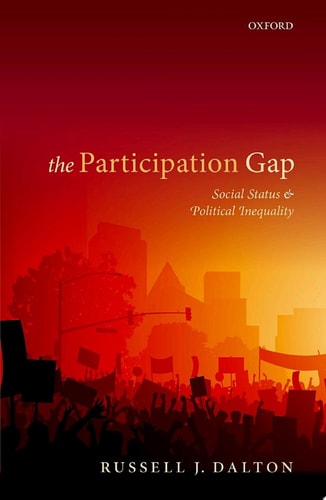
The Participation Gap: Social Status and Political Inequality
0
0
As an Amazon Associate and affiliate partner, Menrva Books earns from qualifying purchases. Learn more
Author Description
The dilemma of democracy arises from two contrasting trends. More people in the established democracies are participating in civil society activity, contacting government officials, protesting, and using online activism and other creative forms of participation. At the same time, the importance of social status as an influence on political activity is increasing. The democratic principle of the equality of voice is eroding. The politically rich are getting richer-and the politically needy have less voice. This book assembles an unprecedented set of international public opinion surveys to identify the individual, institutional, and political factors that produce these trends. New forms of activity place greater demands on participants, raising the importance of social status skills and resources. Civil society activity further widens the participation gap. New norms of citizenship shift how people participate. And generational change and new online forms of activism accentuate this process. Effective and representative government requires a participatory citizenry and equal voice, and participation trends are undermining these outcomes. The Participation Gap both documents the growing participation gap in contemporary democracies and suggests ways that we can better achieve their theoretical ideal of a participatory citizenry and equal voice.
Menrva's Summary
THE THESIS
This book investigates the paradox of modern democracy where increased civic engagement coincides with a widening gap in political influence based on social status. Russell J. Dalton, a prominent political scientist, utilizes extensive international public opinion data to analyze how shifts in citizenship norms, the rise of digital activism, and the demands of modern civil society contribute to political inequality. He argues that the increasing complexity of political participation favors those with higher social status, thereby undermining the democratic ideal of equal voice.
THE SCOPE MAP
What You Will Find
- Comparative analysis of international public opinion surveys across established democracies.
- Examination of the relationship between social status, resource availability, and political efficacy.
- Assessment of how generational shifts and online activism influence traditional political participation.
Scope Limits
- The analysis focuses primarily on established democracies rather than developing political systems.
- The text does not provide a comprehensive policy manual for legislative reform but rather identifies the structural drivers of inequality.
THE AUTHORITY PERSPECTIVE
Experts recognize this work as a significant contribution to the study of democratic participation and political inequality. Scholars frequently cite the book for its rigorous use of cross-national data to explain the evolving nature of civic engagement in the twenty-first century.
Page Count:
252
Publication Date:
2017-01-01
Publisher:
OUP Oxford
ISBN-10:
0192539914
ISBN-13:
9780192539915
Sociology
Democracy
Public Policy
Community Tags
Similar Books