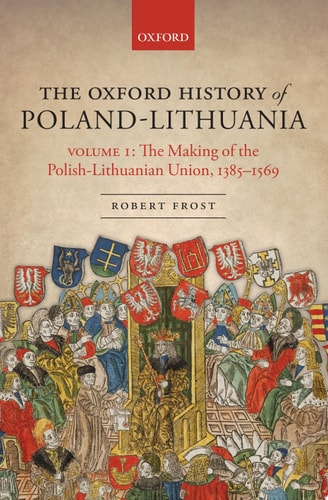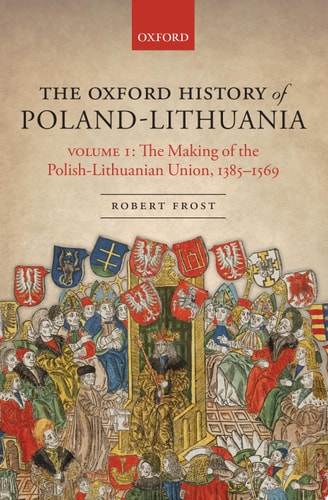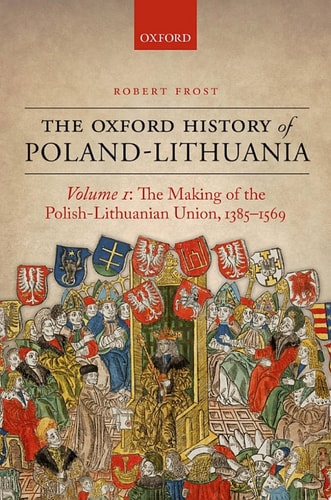
The Oxford History of Poland-Lithuania: Volume I: The Making of the Polish-Lithuanian Union, 1385-1569
0
0
As an Amazon Associate and affiliate partner, Menrva Books earns from qualifying purchases. Learn more
Author Description
The history of eastern European is dominated by the story of the rise of the Russian empire, yet Russia only emerged as a major power after 1700. For 300 years the greatest power in Eastern Europe was the union between the kingdom of Poland and the grand duchy of Lithuania, one of the longest-lasting political unions in European history. Yet because it ended in the late-eighteenth century in what are misleadingly termed the Partitions of Poland, it barely features in standard accounts of European history. The Making of the Polish-Lithuanian Union 1385-1569 tells the story of the formation of a consensual, decentralised, multinational, and religiously plural state built from below as much as above, that was founded by peaceful negotiation, not war and conquest. From its inception in 1385-6, a vision of political union was developed that proved attractive to Poles, Lithuanians, Ruthenians, and Germans, a union which was extended to include Prussia in the 1450s and Livonia in the 1560s. Despite the often bitter disagreements over the nature of the union, these were nevertheless overcome by a republican vision of a union of peoples in one political community of citizens under an elected monarch. Robert Frost challenges interpretations of the union informed by the idea that the emergence of the sovereign nation state represents the essence of political modernity, and presents the Polish-Lithuanian union as a case study of a composite state. The modern history of Poland, Lithuania, Ukraine, and Belarus cannot be understood without an understanding of the legacy of the Polish-Lithuanian union. This volume is the first detailed study of the making of that union ever published in English.
Menrva's Summary
THE THESIS
This volume investigates how the Polish-Lithuanian union functioned as a consensual, multinational, and decentralized political entity rather than a product of conquest. Robert I. Frost, a specialist in the history of the Polish-Lithuanian Commonwealth, utilizes extensive archival research and primary source analysis to argue that the union represents a unique model of a composite state. He challenges traditional historiography that prioritizes the sovereign nation-state as the only valid form of political modernity, instead highlighting the republican vision that sustained the union for centuries.
THE SCOPE MAP
What You Will Find
- Detailed analysis of the political and social formation of the union between 1385 and 1569.
- Examination of the integration of Ruthenian, German, Prussian, and Livonian territories.
- Exploration of the legal and constitutional frameworks governing the elected monarchy.
Scope Limits
- The volume focuses exclusively on the formation period ending in 1569 and does not cover the later decline or the partitions of the eighteenth century.
THE AUTHORITY PERSPECTIVE
Historians recognize this work as a foundational study that fills a significant gap in English-language scholarship regarding Eastern European political structures. Readers frequently note the academic density of the prose, which provides a rigorous and comprehensive examination of the union's complex administrative and social evolution.
Page Count:
592
Publication Date:
2018-01-01
Publisher:
OUP Oxford
ISBN-10:
0192568140
ISBN-13:
9780192568144
History
Polish History
Lithuanian History
Early Modern
European History
Political History