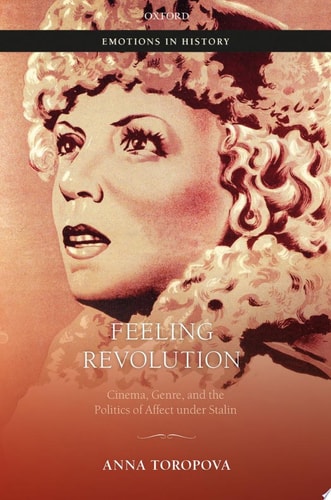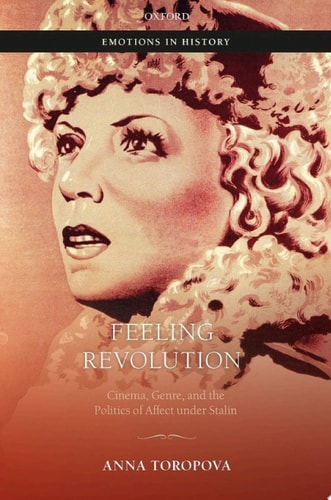
Feeling Revolution: Cinema, Genre, and the Politics of Affect under Stalin
0
0
As an Amazon Associate and affiliate partner, Menrva Books earns from qualifying purchases. Learn more
Author Description
Stalin-era cinema was designed to promote emotional and affective education. The filmmakers of the period were called to help forge the emotions and affects that befitted the New Soviet Person - ranging from happiness and victorious laughter, to hatred for enemies. Feeling Revolution shows how the Soviet film industry's efforts to find an emotionally resonant language that could speak to a mass audience came to centre on the development of a distinctively 'Soviet' cinema. Its case studies of specific film genres, including production films, comedies, thrillers, and melodramas, explore how the genre rules established by Western and prerevolutionary Russian cinema were reoriented to new emotional settings. 'Sovietising' audience emotions did not prove to be an easy feat. The tensions, frustrations, and missteps of this process are outlined in Feeling Revolution, with reference to a wide variety of primary sources, including the artistic council discussions of the Mosfil'm and Lenfil'm studios and the Ministry of Cinematography. Bringing the limitations of the Stalinist ideological project to light, Anna Toropova reveals cinema's capacity to contest the very emotional norms that it was entrusted with crafting.
Menrva's Summary
THE THESIS
This book investigates how the Soviet film industry during the Stalin era attempted to engineer specific emotional responses in the populace to cultivate the 'New Soviet Person.' Anna Toropova, a scholar of Soviet cinema and culture, utilizes archival records from major film studios and state ministries to analyze the intersection of ideological mandates and cinematic production. She argues that the process of 'Sovietising' emotions was fraught with contradictions, revealing that cinema often failed to align perfectly with state-prescribed affective norms.
THE SCOPE MAP
What You Will Find
- Analysis of genre adaptation including production films, comedies, thrillers, and melodramas.
- Examination of artistic council discussions from Mosfil'm and Lenfil'm studios.
- Investigation into the state's attempt to regulate public affect through mass media.
Scope Limits
- The study focuses primarily on the Stalinist period and does not extend into the post-Stalinist era of Soviet cinema.
- It does not provide a comprehensive history of Soviet film technology or industry economics, focusing instead on the politics of emotion.
THE AUTHORITY PERSPECTIVE
Scholars in the field of Slavic studies and film history recognize this work as a significant contribution to understanding the intersection of state ideology and cultural production. Readers frequently note the meticulous use of primary archival sources to demonstrate the complexities of the Stalinist cultural project.
Page Count:
272
Publication Date:
2020-01-01
Publisher:
OUP Oxford
ISBN-10:
0192566830
ISBN-13:
9780192566836
History
Soviet History
Film Studies
Modern History
Media Studies