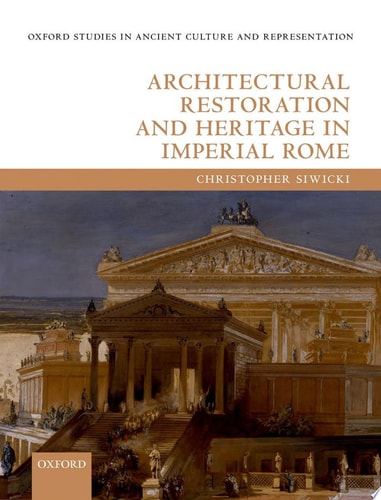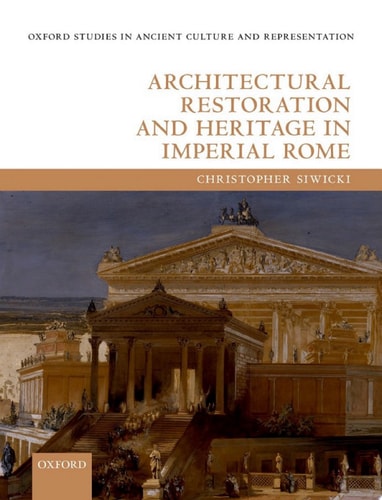
Architectural Restoration and Heritage in Imperial Rome
0
0
As an Amazon Associate and affiliate partner, Menrva Books earns from qualifying purchases. Learn more
Author Description
This volume addresses the treatment and perception of historic buildings in Imperial Rome, examining the ways in which public monuments were restored in order to develop an understanding of the Roman concept of built heritage. It considers examples from the first century BC to the second century AD, focusing primarily on the six decades between the Great Fire of AD 64 and the AD 120s, which constituted a period of dramatic urban transformation and architectural innovation in Rome. Through a detailed analysis of the ways in which the design, materiality, and appearance of buildings - including the temple of Jupiter Capitolinus and hut of Romulus - developed with successive restorations, the case is made for the existence of a consistent approach to the treatment of historic buildings in this period. This study also explores how changes to particular monuments and to the urban fabric as a whole were received by the people who experienced them first-hand, uncovering attitudes to built heritage in Roman society more widely. By examining descriptions of destruction and restoration in literature of the first and second centuries AD, including the works of Seneca the Younger, Pliny the Elder, Martial, Tacitus, and Plutarch, it forms a picture of the conflicting ways in which Rome's inhabitants responded to the redevelopment of their city. The results provide an alternative way of explaining key interventions in Rome's built environment and challenge the idea that heritage is a purely modern phenomenon.
Menrva's Summary
THE THESIS
This volume investigates whether the Roman Empire possessed a conceptual framework for built heritage by analyzing the restoration and perception of historic monuments between the first century BC and the second century AD. Christopher Siwicki, a scholar of Roman architecture, utilizes a combination of archaeological evidence and contemporary literary sources to argue that Romans maintained a consistent, albeit complex, approach to the preservation and modification of their urban environment. By focusing on the period between the Great Fire of AD 64 and the AD 120s, the author demonstrates how architectural interventions reflected evolving societal attitudes toward history and identity.
THE SCOPE MAP
What You Will Find
- Analysis of major monuments including the temple of Jupiter Capitolinus and the hut of Romulus.
- Examination of architectural materiality, design evolution, and urban transformation.
- Synthesis of literary accounts from authors such as Seneca the Younger, Pliny the Elder, Martial, Tacitus, and Plutarch.
Scope Limits
- The study is geographically restricted to the city of Rome.
- The analysis focuses primarily on the period between the first century BC and the second century AD, with a specific emphasis on the six decades following the Great Fire of AD 64.
THE AUTHORITY PERSPECTIVE
Scholars and historians view this work as a significant contribution to the study of Roman urbanism and the history of preservation. Readers frequently note the academic density of the prose and the author's meticulous use of primary source material to challenge modern assumptions about heritage.
Page Count:
320
Publication Date:
2019-01-01
Publisher:
OUP Oxford
ISBN-10:
0192588214
ISBN-13:
9780192588210
History
Architecture
Historic buildings
Ancient History
Archaeology
Ancient - Rome