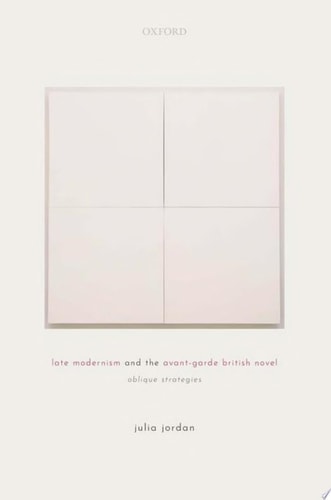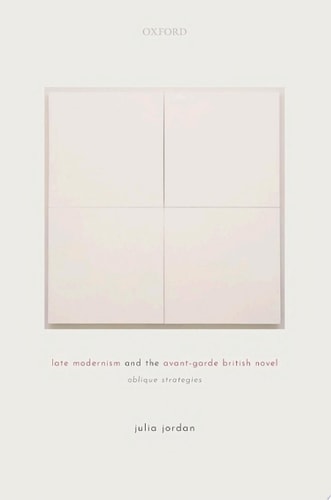
Late Modernism and the Avant-Garde British Novel: Oblique Strategies
0
0
As an Amazon Associate and affiliate partner, Menrva Books earns from qualifying purchases. Learn more
Author Description
In the decades following the immediately postwar period in Britain, a loose grouping of experimental writers that included Alan Burns, Christine Brooke-Rose, B. S. Johnson, and Ann Quin worked against the dominance, as they saw it, of the realist novel of the literary mainstream. Late Modernism and the Avant-Garde British Novel reassesses the experimentalism versus realism debates of the period, and finds a body of work engaged with, rather than merely antagonistic towards, the literary culture it sought to renovate. Charting these engagements, it shows how they have significance not just for our understanding of these decades but for the broader movement of the novel through the century. This volume takes some of the claims made about experimental fiction—that it is unreadable, nonlinear, elliptical, errant, plotless—and reimagines these descriptors as historically inscribed tendencies that express the period's investment in the idea of the accidental. These novels are interested in the fleeting and the fugitive, in discontinuity and shock. The experimental novel cultivates an interest in methods of representation that are oblique: attempting to conjure the world at an angle, or in the rear-view mirror; by ellipsis or evasion. These concepts—error, indeterminacy, uncertainty, accident—all bear a relation to that which evades or resists interpretation and meaning. Asking what are the wider political, ethical, and philosophical correlates of this incommensurability, Late Modernism and the Avant-Garde British Novel reads experimental literature in this light, as suffused with anxiety about its adequacy in the light of its status as necessarily imitative and derivative, and therefore redolent of the forms of not-knowing and uncertainty that mark late modernism more generally.
Menrva's Summary
THE THESIS
This book investigates how experimental British novelists in the post-war era utilized oblique narrative strategies to challenge the dominance of realism while engaging with the broader philosophical and political anxieties of their time. Julia Jordan, a scholar of twentieth-century literature, examines the works of writers such as Alan Burns, Christine Brooke-Rose, B. S. Johnson, and Ann Quin. She argues that the perceived 'unreadability' of these texts is not a failure of communication but a deliberate historical engagement with concepts of accident, error, and indeterminacy. By framing these experimental techniques as historically inscribed tendencies, the author provides a new framework for understanding the evolution of the novel in the late twentieth century.
THE SCOPE MAP
What You Will Find
- Analysis of post-war British experimental fiction and its departure from mainstream realism.
- A theoretical framework linking literary techniques like ellipsis and nonlinearity to the philosophical concept of the 'accidental.'
- Critical readings of authors including B. S. Johnson, Ann Quin, and Christine Brooke-Rose.
- Exploration of the political and ethical implications of narrative incommensurability.
Scope Limits
- The text focuses primarily on a specific cohort of British experimentalists and does not provide a comprehensive survey of all post-war British literature.
- It does not offer a general history of the novel but rather a specialized study of late modernist tendencies.
THE AUTHORITY PERSPECTIVE
Scholars and critics recognize this work as a significant contribution to the study of late modernism and the history of the experimental novel. Readers frequently note the academic density of the prose, which is intended for an audience familiar with literary theory and twentieth-century British literary history.
Page Count:
255
Publication Date:
2020-01-01
Publisher:
OUP Oxford
ISBN-10:
0192599216
ISBN-13:
9780192599216
History
Literary Criticism
Literary theory
Avant-garde
History of the Novel
British literature
Modernism
Indigenous