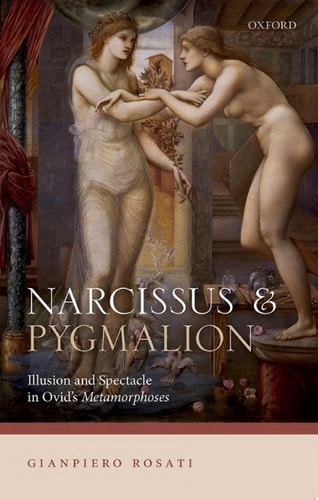
Narcissus and Pygmalion: Illusion and Spectacle in Ovid's Metamorphoses
0
0
As an Amazon Associate and affiliate partner, Menrva Books earns from qualifying purchases. Learn more
Author Description
Nature imitates art--not a paradox from Oscar Wilde's pen, but instead the bold formulation of the Latin poet Ovid (43 BCE-17 CE), marking a radical turning point in ancient aesthetics, founded on the principle of mimesis. For Ovid, art is independent of reality, not its mirror: by enhancing phantasia, the artist's creative imagination and the simulacrum's primacy over reality, Ovid opens up unexplored perspectives for future European literature and art. Through an examination of Narcissus and Pygmalion, figures of illusion and desire, who are the protagonists of two major episodes of the Metamorphoses, Rosati sheds light on some crucial junctures in the history of reception and aesthetics. Narcissus and Pygmalion has, since its first publication in Italian, contributed to the poet's critical fortunes over the past few decades through its combination of sophisticated literary critical thinking and patient argument applied to the poetics of self-reflexivity and, in particular, to the fundamental interface between the verbal and the visual in the Metamorphoses. A substantial introduction accompanies this new translation into English, positioning Rosati's work anew in the forefront of current discussions of Ovidian aesthetics and intermediality, in the wake of the postmodern culture of the simulacrum.
Menrva's Summary
THE THESIS
How does Ovid’s treatment of Narcissus and Pygmalion redefine the relationship between art and reality through the lens of mimesis and the simulacrum? Gianpiero Rosati, a scholar of Latin literature, investigates the aesthetic shift in Ovid’s work where art ceases to be a mere mirror of nature and becomes an independent, creative force. By analyzing the interplay between verbal and visual elements, Rosati argues that Ovid anticipates modern concepts of the simulacrum and the primacy of the imagination in the creative process.
THE SCOPE MAP
What You Will Find
- Analysis of the Narcissus and Pygmalion episodes within Ovid's Metamorphoses
- Exploration of the concept of phantasia and its role in ancient aesthetics
- Examination of the interface between verbal description and visual representation
Scope Limits
- The text focuses specifically on Ovidian aesthetics rather than a comprehensive survey of all Roman poetry
- It does not provide a general biography of Ovid but concentrates on his theoretical contributions to art history
THE AUTHORITY PERSPECTIVE
Scholars recognize this work as a significant contribution to the study of Ovidian poetics and the reception of classical aesthetics in modern theory. Readers frequently note the academic density of the prose, which serves as a rigorous examination of the intersection between classical literature and postmodern concepts of the simulacrum.
Page Count:
201
Publication Date:
2021-01-01
Publisher:
OUP Oxford
ISBN-10:
019259365X
ISBN-13:
9780192593658
Literary Criticism
English
English & College Success
Poetics
Aesthetics
Ovid
Community Tags
Similar Books