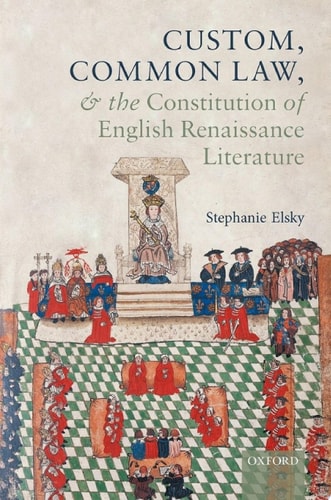
Custom, Common Law, and the Constitution of English Renaissance Literature
0
0
As an Amazon Associate and affiliate partner, Menrva Books earns from qualifying purchases. Learn more
Author Description
Custom, Common Law, and the Constitution of English Renaissance Literature argues that, ironically, custom was a supremely generative literary force for a range of Renaissance writers. Custom took on so much power because of its virtual synonymity with English common law, the increasingly dominant legal system that was also foundational to England's constitutionalist politics. The strange temporality assigned to legal custom, that is, its purported existence since 'time immemorial', furnished it with a unique and paradoxical capacity--to make new and foreign forms familiar. This volume shows that during a time when novelty was suspect, even insurrectionary, appeals to the widespread understanding of custom as a legal concept justified a startling array of fictive experiments. This is the first book to reveal fully the relationship between Renaissance literature and legal custom. It shows how writers were able to reimagine moments of historical and cultural rupture as continuity by appealing to the powerful belief that English legal custom persisted in the face of conquests by foreign powers. Custom, Common Law, and the Constitution of English Renaissance Literature thus challenges scholarly narratives in which Renaissance art breaks with a past it looks back upon longingly and instead argues that the period viewed its literature as imbued with the aura of the past. In this way, through experiments in rhetoric and form, literature unfolds the processes whereby custom gains its formidable and flexible political power. Custom, a key concept of legal and constitutionalist thought, shaped sixteenth-century literature, while this literature, in turn, transformed custom into an evocative mythopoetic.
Menrva's Summary
THE THESIS
This book investigates how the legal concept of custom served as a generative force for literary innovation in English Renaissance writing. Stephanie Elsky, an academic specializing in early modern literature and legal history, argues that the common law principle of 'time immemorial' allowed writers to frame new, experimental forms as ancient and continuous. By examining the intersection of legal theory and poetic practice, the author demonstrates how Renaissance authors utilized the flexibility of custom to navigate political and cultural change without appearing insurrectionary.
THE SCOPE MAP
What You Will Find
- Analysis of the relationship between English common law and literary form
- Examination of sixteenth-century rhetorical experiments
- Discussion of the mythopoetic function of legal concepts in literature
Scope Limits
- The study focuses primarily on English Renaissance literature and does not extend to continental European legal traditions
- The work does not provide a comprehensive history of common law, but rather focuses on its intersection with literary production
THE AUTHORITY PERSPECTIVE
Scholars in the field of law and literature identify this text as a significant contribution to understanding how early modern writers engaged with legal frameworks. Readers frequently note the academic density of the prose and the rigorous historical research supporting the author's claims.
Page Count:
238
Publication Date:
2020-01-01
Publisher:
OUP Oxford
ISBN-10:
0192605852
ISBN-13:
9780192605856
English literature
English & College Success
Legal History
Constitutional History
Literary Criticism
English Renaissance
English