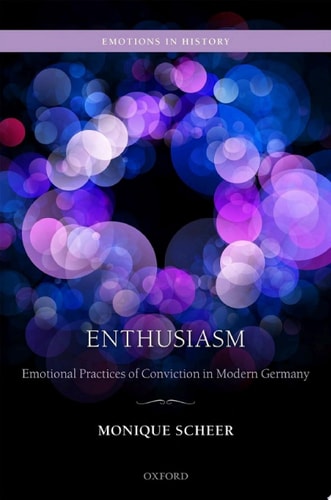
Enthusiasm: Emotional Practices of Conviction in Modern Germany
0
0
As an Amazon Associate and affiliate partner, Menrva Books earns from qualifying purchases. Learn more
Author Description
Enthusiasm seeks to contribute to a culturally and historically nuanced understanding of how emotions secure and ratify the truth of convictions. More than just pure affective intensity, enthusiasm is about something: a certainty, clarity, or truth. Neither as clearly negative as fanaticism nor as general as passion, enthusiasm specifically entails belief. For this reason, the book takes its starting point in religion, the social arena in which the concept was first debated and to which the term still gestures. Empirically based in modern German Protestantism, where religious emotion is intensely cultivated but also subject to vigorous scrutiny, it combines historical and ethnographic methods to show how enthusiasm has been negotiated and honed as a practice in Protestant denominations ranging from liberal to charismatic. The nexus of religion and emotion and how it relates to central concepts of modernity such as rationality, knowledge, interiority, and sincerity are key to understanding why moderns are so ambivalent about enthusiasm. Grounded in practice theory, Enthusiasm assumes that emotions are not an affective state we 'have' but mind-body activations we 'do', having learned to perform them in culturally specific ways. When understood as an emotional practice, enthusiasm has different styles, inflected by historical traditions, social milieus, and knowledge (even ideologies) about emotions and how they work. Enthusiasm also provides insight into how this feeling works in secular humanism as well as in politics, and why it is so contested as a practice in any context.
Menrva's Summary
THE THESIS
This book investigates how enthusiasm functions as a culturally learned emotional practice that validates convictions and shapes modern religious and secular experiences. Monique Scheer, a scholar specializing in the history of emotions, utilizes a practice-theory framework to argue that emotions are not passive states but active, learned mind-body performances. By examining modern German Protestantism, the author demonstrates how these emotional practices are negotiated within specific social and historical contexts to reconcile the tension between intense belief and modern rationality.
THE SCOPE MAP
What You Will Find
- Analysis of emotional practices within liberal to charismatic German Protestant denominations.
- Application of practice theory to the study of religious and secular conviction.
- Examination of the intersection between emotion and modernity, including concepts of sincerity and interiority.
- Historical and ethnographic methodology combining archival research with contemporary observation.
Scope Limits
- The study is primarily focused on the German Protestant context and does not provide a global survey of enthusiasm across all world religions.
- The text does not offer a psychological or neurobiological explanation of emotion, focusing instead on cultural and historical performance.
THE AUTHORITY PERSPECTIVE
Scholars in the history of emotions recognize this work as a significant contribution to the field for its rigorous application of practice theory to religious studies. Readers frequently note the academic density of the prose, which is best suited for those familiar with historical and sociological discourse.
Page Count:
255
Publication Date:
2021-01-01
Publisher:
OUP Oxford
ISBN-10:
0192608916
ISBN-13:
9780192608918
Religion
History
Sociology
Special Topics
German history
Emotions
Community Tags
Similar Books