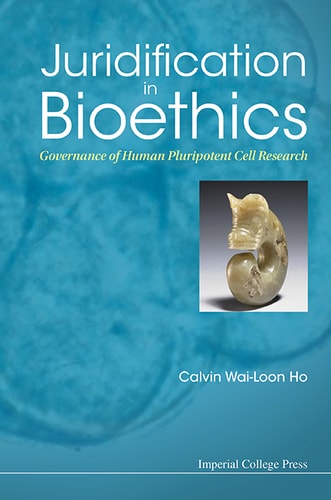
Juridification In Bioethics: Governance Of Human Pluripotent Cell Research
0
0
As an Amazon Associate and affiliate partner, Menrva Books earns from qualifying purchases. Learn more
Author Description
What is 'legal' about bioethics? What are the ideas and artefacts that bioethics encompasses, and how are they related to law? What is the role of law in bioethics? In this work, Calvin Ho attempts to address these questions in the context of the governance of human pluripotent stem cell research. In essence, he argues that the hybridization of law, through processes, devices and techniques of juridification, has helped to constitute bioethics as a public sphere and an emergent civic epistemology.Drawing on his multi-sited ethnographic fieldwork and on Actor-Network-Theory, Ho explains how the law has, through bioethics, contributed to the scientific and public understanding of human pluripotent stem cell research and its artefacts, particularly the embryo and human-animal combinations. Although the focus of his work is on bioethical developments in Singapore over a period of more than 15 years, parallel developments in key jurisdictions (especially the United States of America and the United Kingdom) and in international science policy are also evaluated. It is through appreciating how it has progressed that bioethics will be better able to engage with future challenges presented by advances in human embryo research and gene editing techniques, among others.
Menrva's Summary
THE THESIS
This work investigates the intricate relationship between law and bioethics, specifically examining how legal frameworks shape the governance of human pluripotent cell research. Calvin Wai-Loon Ho explores the concept of 'juridification' to demonstrate how legal processes and devices have constituted bioethics as a public sphere and an emergent civic epistemology. Utilizing multi-sited ethnographic fieldwork and Actor-Network-Theory, the book details how law has influenced the scientific and public understanding of stem cell research, focusing on key artifacts like the embryo and human-animal combinations. The analysis, while centered on Singapore over 15 years, also incorporates comparative insights from the United States, the United Kingdom, and international science policy to address future challenges in embryo research and gene editing.
THE SCOPE MAP
- Analysis of the legal dimensions of bioethics.
- Exploration of the role of law in constituting bioethics as a public sphere.
- Application of Actor-Network-Theory to understand scientific and public engagement with bioethics.
- Case study of human pluripotent stem cell research governance in Singapore.
- Comparative analysis of legal and policy developments in the US, UK, and international science policy.
- Discussion of future challenges in human embryo research and gene editing.
THE AUTHORITY PERSPECTIVE
This book offers a detailed examination of the legal underpinnings of bioethics, particularly within the context of stem cell research. It is likely to be of interest to scholars and policymakers in bioethics, law, and science policy who are interested in the intersection of these fields. The work's focus on juridification and its application through ethnographic fieldwork suggests a rigorous, theoretically informed approach to understanding governance.
Page Count:
504
Publication Date:
2016-07-28
Publisher:
World Scientific Publishing Company
ISBN-10:
1911299638
ISBN-13:
9781911299639
Science
Politics
Non-Fiction
Bioethics
Science Policy
Law
Sociology of Science
Community Tags
Similar Books