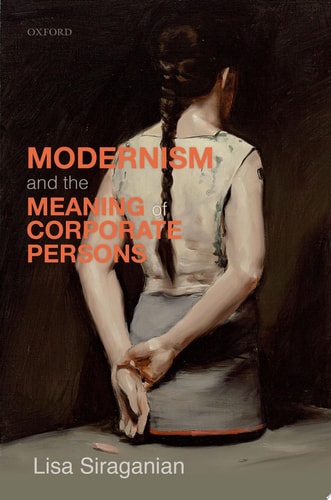
Modernism and the Meaning of Corporate Persons
0
0
As an Amazon Associate and affiliate partner, Menrva Books earns from qualifying purchases. Learn more
Author Description
Long Before The Us Supreme Court Announced That Corporate Persons Freely Speak With Money In Citizens United V. Federal Election Commission (2010), They Elaborated The Legal Fiction Of American Corporate Personhood In Santa Clara V. Southern Pacific Railroad (1886). Yet Endowing A Non-human Entity With Certain Rights Exposed A Fundamental Philosophical Question About The Possibility Of Collective Intention. That Question Extended Beyond The Law And Became Essential To Modern American Literature. This Volume Offers The First Multidisciplinary Intellectual History Of This Story Of Corporate Personhood. The Possibility That Large Collective Organizations Might Mean To Act Like Us, Like Persons, Animated A Diverse Set Of American Writers, Artists, And Theorists Of The Corporation In The First Half Of The Twentieth Century, Stimulating A Revolution Of Thought On Intention. The Ambiguous Status Of Corporate Intention Provoked Conflicting Theories Of Meaning—on The Relevance (or Not) Of Authorial Intention And The Interpretation Of Collective Signs Or Social Forms—still Debated Today. As Law Struggled With Opposing Arguments, Modernist Creative Writers And Artists Grappled With Interrelated Questions, Albeit Under Different Guises And Formal Procedures. Combining Legal Analysis Of Law Reviews, Treatises, And Case Law With Literary Interpretation Of Short Stories, Novels, And Poems, This Volume Analyzes Legal Philosophers Including Oliver Wendell Holmes, Jr., Frederic Maitland, Harold Laski, Maurice Wormser, And Creative Writers Such As Theodore Dreiser, Muriel Rukeyser, Gertrude Stein, Charles Reznikoff, F. Scott Fitzgerald, And George Schuyler.
Menrva's Summary
THE THESIS
This volume investigates how the legal fiction of corporate personhood in the United States fundamentally shaped the philosophical understanding of collective intention within early twentieth-century American literature. Lisa Siraganian, an expert in modernist studies, synthesizes legal history with literary analysis to demonstrate that the ambiguity surrounding corporate agency mirrored contemporary debates regarding authorial intent and the interpretation of social signs. By bridging the gap between legal treatises and creative texts, the author argues that the corporation served as a critical site for exploring the limits of human and non-human personhood.
THE SCOPE MAP
What You Will Find
- A multidisciplinary analysis of legal philosophers including Oliver Wendell Holmes, Jr., Frederic Maitland, and Harold Laski.
- Literary interpretations of works by Theodore Dreiser, Gertrude Stein, F. Scott Fitzgerald, and others.
- An examination of the intersection between legal theory and modernist formal experimentation.
Scope Limits
- The study is primarily restricted to the first half of the twentieth century.
- It does not provide an exhaustive history of corporate law post-1950.
THE AUTHORITY PERSPECTIVE
Scholars recognize this work as a significant contribution to the field of law and literature, noting its ability to synthesize complex legal doctrines with modernist aesthetic theory. Readers frequently highlight the academic density of the prose, which demands a high level of familiarity with both legal history and literary criticism.
Page Count:
320
Publication Date:
2020-01-01
Publisher:
Oxford University Press
ISBN-10:
0192639625
ISBN-13:
9780192639622
Philosophy
Modernism
Legal History
Literary Criticism
Corporate Law
American
Community Tags
Other Editions(3)

Similar Books


Reader Comments
Share Your Thoughts
No comments yet. Be the first to share your thoughts!