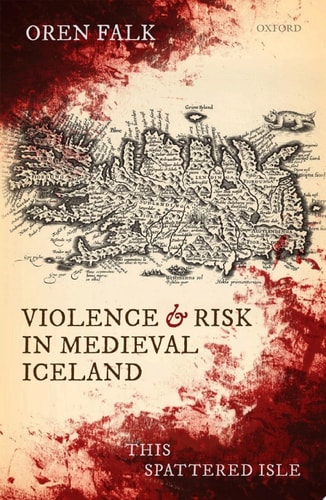
Violence and Risk in Medieval Iceland: This Spattered Isle
0
0
As an Amazon Associate and affiliate partner, Menrva Books earns from qualifying purchases. Learn more
Author Description
Historians spend a lot of time thinking about violence: bloodshed and feats of heroism punctuate practically every narration of the past. Yet historians have been slow to subject 'violence' itself to conceptual analysis. What aspects of the past do we designate violent? To what methodological assumptions do we commit ourselves when we employ this term? How may we approach the category 'violence' in a specifically historical way, and what is it that we explain when we write its history? Astonishingly, such questions are seldom even voiced, much less debated, in the historical literature. Violence and Risk in Medieval Iceland: This Spattered Isle lays out a cultural history model for understanding violence. Using interdisciplinary tools, it argues that violence is a positively constructed asset, deployed along three principal axes - power, signification, and risk. Analysing violence in instrumental terms, as an attempt to coerce others, focuses on power. Analysing it in symbolic terms, as an attempt to communicate meanings, focuses on signification. Finally, analysing it in cognitive terms, as an attempt to exercise agency despite imperfect control over circumstances, focuses on risk. Violence and Risk in Medieval Iceland explores a place and time notorious for its rampant violence. Iceland's famous sagas hold treasure troves of circumstantial data, ideally suited for past-tense ethnography, yet demand that the reader come up with subtle and innovative methodologies for recovering histories from their stories. The sagas throw into sharp relief the kinds of analytic insights we obtain through cultural interpretation, offering lessons that apply to other epochs too.
Menrva's Summary
THE THESIS
This work investigates how violence functioned as a culturally constructed asset in medieval Iceland, challenging historians to move beyond mere narration of bloodshed toward a rigorous conceptual analysis of the term. Oren Falk, a scholar of medieval history, utilizes the Icelandic sagas as a primary data source to develop a cultural history model. He argues that violence should be understood through three distinct analytical axes: power, signification, and risk. By applying these lenses, the author demonstrates how violence served as a tool for coercion, communication, and the exercise of agency within an environment of imperfect control.
THE SCOPE MAP
What You Will Find
- A cultural history framework for analyzing violence in historical contexts.
- An examination of medieval Icelandic society through the lens of the sagas.
- A tripartite methodology focusing on power, signification, and risk.
- Application of past-tense ethnography to literary sources.
Scope Limits
- The study does not provide a comprehensive chronological narrative of Icelandic political history.
- It does not focus on the biological or psychological origins of human aggression.
THE AUTHORITY PERSPECTIVE
Scholars recognize this text as a significant contribution to the methodology of historical analysis, particularly regarding the interpretation of saga literature. Readers frequently note the academic density of the prose and the innovative nature of the author's interdisciplinary approach.
Page Count:
372
Publication Date:
2021-01-01
Publisher:
OUP Oxford
ISBN-10:
0192635573
ISBN-13:
9780192635570
History
Anthropology
Violence
European History
Sagas
Cultural History
Sociology of Violence
Icelandic History
Community Tags
Similar Books