Dante's New Life of the Book: A Philology of World Literature
0
0
As an Amazon Associate and affiliate partner, Menrva Books earns from qualifying purchases. Learn more
Author Description
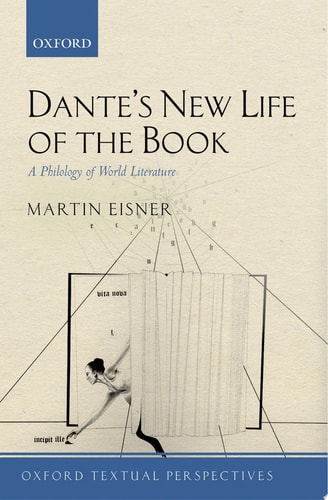
Dante's Vita nuova has taken on a wide variety of different forms since its first publication in 1294. How could one work have generated such different physical forms? Through examining the work's transformations in manuscripts, printed books, translations, and adaptations, Eisner reconceives of the relationship between the work and its reception. Dante's New Life of the Book investigates how these different material manifestations participate in the work, drawing attention to its distinctive elements. Dante framed his book as an attempt to understand his own experiences through the experimental form of the book, and later scribes, editors, and translators use different material forms to embody their interpretations of Dante's collection of thirty-one poems surrounded by prose narrative and commentary. Traveling from Boccaccio's Florence to contemporary Hollywood with stops in Emerson's Cambridge, Rossetti's London, Nerval's Paris, Mandelstam's Russia, De Campos's Brazil, and Pamuk's Istanbul, this study builds on extensive archival research to show how Dante's strange poetic forms, including incomplete canzoni and sonnets with two beginnings, continue to challenge readers. Each chapter focuses on how one of these distinctive features has been treated over time, offering new perspectives on topics such as Dante's love of Beatrice, his relationship with Guido Cavalcanti, and his attraction to another woman. Numerous illustrations show the entanglement of the work's poetic form and its material survival. Eisner provides a fresh reading of Dante's innovations, demonstrating the value of this philological analysis of the work's survival in the world.
Menrva's Summary
THE THESIS
How does the material history of Dante's Vita nuova shape the interpretation and reception of the work across centuries and cultures? Martin Eisner, a scholar of Italian literature, utilizes archival research and philological analysis to argue that the physical form of the book—from manuscripts to modern translations—is not merely a container but an active participant in the meaning of Dante's text. By examining the specific poetic structures Dante employed, Eisner demonstrates how editors, translators, and readers have continuously reinterpreted the work through their own material interventions.
THE SCOPE MAP
What You Will Find
- A historical analysis of the Vita nuova from 1294 to the present day.
- Case studies of the work's reception in diverse locations including Florence, London, Paris, Russia, Brazil, and Istanbul.
- Examination of specific poetic features such as incomplete canzoni and dual-start sonnets.
- Analysis of the interplay between prose commentary and poetic verse.
Scope Limits
- The study does not provide a comprehensive biography of Dante Alighieri.
- It does not offer a general literary history of the Middle Ages outside the specific context of the Vita nuova.
THE AUTHORITY PERSPECTIVE
Scholars in the field of medieval studies and book history recognize this work as a significant contribution to the understanding of textual transmission and reception theory. Readers frequently note the academic density of the prose, which requires a foundational knowledge of Dante's work to fully appreciate the philological arguments presented.
Page Count:
288
Publication Date:
2021-01-01
Publisher:
OUP Oxford
ISBN-10:
0192640933
ISBN-13:
9780192640932
World Literature
English
Book History
English & College Success
Literary Criticism
Philology
Community Tags
Similar Books