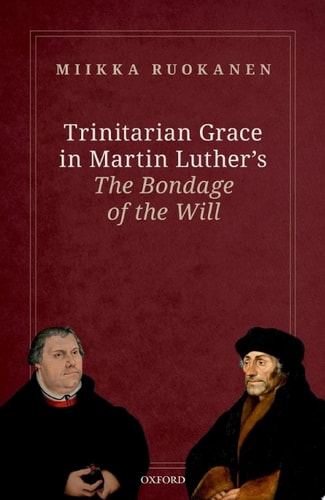
Trinitarian Grace in Martin Luther's The Bondage of the Will
0
0
As an Amazon Associate and affiliate partner, Menrva Books earns from qualifying purchases. Learn more
Author Description
Miikka Ruokanen reveals the powerfully Trinitarian and participatory nature of Martin Luther's conception of divine grace in his magnum opus The Bondage of the Will. The study establishes a genuinely new understanding of Luther's major treatise opening up its ecumenical potential. Luther's debate with Erasmus signifies not only a disagreement concerning free will, but the dispute reveals two contrasting understandings of the very core idea of the Christian faith. For Erasmus, the relationship of the human being with God is based on the rationally and morally acceptable principles of fair play. For Luther, the human being is captivated by the overwhelming power of unfaith and transcendental evil, Satan; only the monergistic grace of the Triune God and the power of the Holy Spirit can liberate him/her. Ruokanen verifies the Trinitarian vision of salvation “by grace alone” as the center of Luther's theology. This doctrine has three dimensions. Firstly, the conversion of the sinner and the birth of faith in Christ are effected by prevenient divine grace; justification “through faith alone,” is the sole work of God's Spirit, comparable to creation ex nihilo. Secondly, participation in the person, life, and divine properties of Christ, as well as participation in his salvific work, his cross and resurrection, are possible solely because of the presence of the Holy Spirit in the believer. Justification means simultaneously the forensic declaration of the guilty non-guilty on the basis of the atonement by Jesus' cross, as well as a union with Christ in the Holy Spirit. Thirdly, sanctification means the gradual growth of love for God and neighbor enabled by the believer's participation in divine love in the Holy Spirit. Ruokanen's work offers a crucial modification and advance to the world-renowned Finnish school of Luther interpretation: Luther's classic use of Pneumatological language avoids the problems caused by using an ontological language.
Menrva's Summary
THE THESIS
This study investigates the Trinitarian and participatory dimensions of divine grace within Martin Luther's treatise, The Bondage of the Will. Miikka Ruokanen, a scholar of systematic theology, utilizes a rigorous analysis of Luther's primary texts to challenge traditional interpretations of the reformer's work. By contrasting Luther's theology with the rationalist framework of Erasmus, the author argues that the core of Luther's thought is a monergistic, Spirit-led liberation from transcendental evil.
THE SCOPE MAP
What You Will Find
- A detailed examination of the debate between Martin Luther and Erasmus regarding free will.
- A tripartite framework of grace: prevenient conversion, participation in Christ, and sanctification through the Holy Spirit.
- An analysis of the Finnish school of Luther interpretation and its evolution.
Scope Limits
- The study does not provide a comprehensive biography of Martin Luther.
- The text does not engage with modern secular critiques of Reformation theology.
THE AUTHORITY PERSPECTIVE
Scholars recognize this work as a significant contribution to the Finnish school of Luther interpretation, particularly for its focus on Pneumatological language. Readers frequently note the academic density of the prose, which is intended for students and researchers of historical theology.
Page Count:
236
Publication Date:
2021-01-01
Publisher:
OUP Oxford
ISBN-10:
0192648969
ISBN-13:
9780192648969
Religion
Theology
Christian Doctrine
Reformation History
Martin Luther
Theology doctrinal
Community Tags
Similar Books