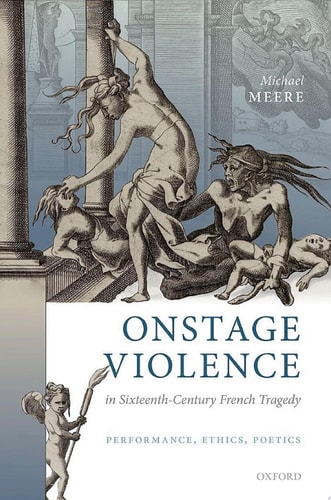
Onstage Violence in Sixteenth-Century French Tragedy: Performance, Ethics, Poetics
0
0
As an Amazon Associate and affiliate partner, Menrva Books earns from qualifying purchases. Learn more
Author Description
The performance of violence on the stage has played an integral role in French tragedy since its inception. Onstage Violence in Sixteenth-Century French Tragedy is the first book to tell this story. It traces and examines the ethical and poetic stakes of violence, as playwrights were experimenting with the newly discovered genre during decades of religious and civil war (c. 1550-1598). The study begins with an overview of the origins of French vernacular tragedy and the complex relationships between violence, performance, ethics, and poetics. The volume focuses on specific plays and analyzes biblical, mythological, historical, and politically topical tragedies--including the stories of Cain and Abel, David and Goliath, Medea, the Sultan Süleyman the Magnificent, the Roman general Regulus, and the assassination of the Duke of Guise in 1588--to show how the multifarious uses of violence on stage shed light on a range of pressing issues during that turbulent time, such as religion, gender, politics, and militantism.
Menrva's Summary
THE THESIS
This study investigates how the representation of violence in sixteenth-century French tragedy functioned as a critical intersection of ethical, political, and poetic discourse during a period of intense civil and religious conflict. Michael Meere, a scholar of early modern French literature, utilizes a framework that bridges performance theory and historical context to analyze how playwrights navigated the volatile landscape of the French Wars of Religion. By examining the shift from classical models to vernacular experimentation, the author argues that stage violence served as a sophisticated tool for exploring contemporary anxieties regarding power, identity, and militantism.
THE SCOPE MAP
What You Will Find
- Analysis of French vernacular tragedy between 1550 and 1598
- Examination of biblical, mythological, and historical dramatic narratives
- Exploration of the intersection between theatrical performance and political reality
- Case studies including the stories of Medea, David and Goliath, and the assassination of the Duke of Guise
Scope Limits
- The study is restricted to the sixteenth-century French theatrical tradition
- It does not provide a comprehensive history of French tragedy beyond the specified period of civil war
THE AUTHORITY PERSPECTIVE
Scholars recognize this work as a primary resource for understanding the evolution of early modern French drama and its relationship to contemporary political violence. Readers frequently note the academic rigor and the depth of the historical contextualization provided by the author.
Page Count:
249
Publication Date:
2021-01-01
Publisher:
OUP Oxford
ISBN-10:
0192658026
ISBN-13:
9780192658029
History
Theater Studies
French literature
English & College Success
Performance Studies
English
Literary Criticism
Community Tags
Similar Books