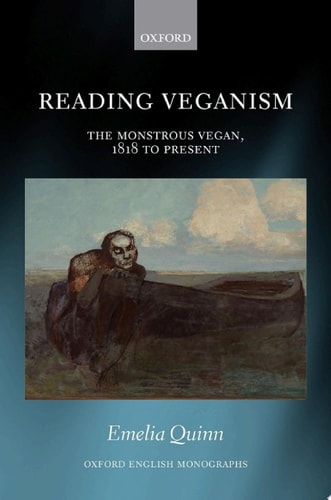
Reading Veganism: The Monstrous Vegan, 1818 to Present
0
0
As an Amazon Associate and affiliate partner, Menrva Books earns from qualifying purchases. Learn more
Author Description
Reading Veganism: The Monstrous Vegan, 1818 to Present focuses on the iteration of the trope 'the monstrous vegan' across two hundred years of Anglophone literature. Explicating, through such monsters, veganism's relation to utopian longing and challenge to the conceptual category of the 'human,' the book explores ways in which ethical identities can be written, represented, and transmitted. Reading Veganism proposes that we can recognise and identify the monstrous vegan in relation to four key traits. First, monstrous vegans do not eat animals, an abstinence that generates a seemingly inexplicable anxiety in those who encounter them. Second, they are hybrid assemblages of human and nonhuman animal parts, destabilising existing taxonomical classifications. Third, monstrous vegans are sired outside of heterosexual reproduction, the product of male acts of creation. And finally, monstrous vegans are intimately connected to acts of writing and literary creation. The principle contention of the book is that understandings of veganism, as identity and practice, are limited without a consideration of multiplicity, provisionality, failure, and insufficiency within vegan definition and lived practice. Veganism's association with positivity, in its drive for health and purity, is countered by a necessary and productive negativity generated by a recognition of the horrors of the modern world. Vegan monsters rehearse the key paradoxes involved in the writing of vegan identity.
Menrva's Summary
THE THESIS
This book investigates the recurring literary trope of the 'monstrous vegan' to analyze how veganism challenges traditional definitions of the human and explores the complexities of ethical identity. Emelia Quinn, an academic specializing in animal studies and literature, utilizes a framework of literary analysis to examine how veganism is represented in Anglophone texts from 1818 to the present. By identifying four specific traits—abstinence from animal products, hybridity, non-heterosexual creation, and a connection to writing—the author argues that veganism is best understood through its inherent paradoxes, failures, and productive negativity rather than purely through ideals of health or purity.
THE SCOPE MAP
What You Will Find
- A historical survey of the 'monstrous vegan' trope spanning two centuries of literature.
- A four-part analytical framework for identifying and deconstructing vegan representation.
- Theoretical exploration of the intersection between veganism, utopianism, and the 'human' category.
Scope Limits
- The analysis is restricted to Anglophone literature and does not cover non-English language texts.
- The study focuses specifically on the 'monstrous' iteration of the vegan identity rather than a comprehensive history of veganism as a social movement.
THE AUTHORITY PERSPECTIVE
Scholars in the fields of animal studies and literary theory identify this work as a significant contribution to the growing body of vegan studies. Readers frequently note the academic density of the prose and the rigor with which the author applies critical theory to the intersection of ethics and literature.
Page Count:
198
Publication Date:
2021-01-01
Publisher:
OUP Oxford
ISBN-10:
019265540X
ISBN-13:
9780192655400
History
Philosophy
Literary Criticism
English literature
Animal Studies
Vegan Studies
Indigenous
Academic